That's the short answer. The longer one is why most people never reach it.
We're Dr. Ruslan Maidans (PhD, Biomedical Engineering) and Dr. Yalda Shahriari (DDS), the doctors and parents behind NOWATA. While developing our soap, we counted every hand hygiene moment our family hit on one ordinary Saturday. The total: 15 to 20. Fewer than half happened anywhere near a sink.
That count changed how we think about technique. Knowing the 7 steps of hand hygiene was never the hard part. Doing them, in full, at the right moments, as often as your day demands, is.
What this page covers:
How often you should actually practice the 7-step technique, and what the research says about a daily number
Why a partial wash misses the zones where germs concentrate most
How the 5 moments and 7 steps of hand hygiene decide your real daily count
How long each practice should take, at a sink and away from one
What two doctors learned about keeping the habit when water isn't an option
The steps take 20 seconds. The frequency is where families win or lose. Here's how to get it right.
TL;DR Quick Answers
7 steps of hand hygiene
The 7 steps of hand hygiene cover every surface of both hands: palms, backs of hands, between fingers, backs of fingers, thumbs, fingertips and nails, and wrists. Scrub for at least 20 seconds with soap and water, or rub until dry with a hand rub.
How often should you practice the 7-step handwashing technique?
Every time you clean your hands. For most adults, that's six to ten times a day, driven by five moments: before food, after the restroom, after coughing or sneezing, after shared surfaces, and after animals or waste. Washing six to ten times daily was linked to a 36% lower risk of seasonal coronavirus infection in UCL research.
What if there's no sink?
Run the same seven steps with a hand rub or a rinse-free soap. NOWATA's plant-based formula clumps as you rub, then brushes off, with no water needed.*
Top Takeaways
Practice the 7 steps every time you clean your hands.
A partial wash skips thumbs, fingertips and the backs of fingers, where germs concentrate most
Six to ten times a day is a research-backed benchmark.
UCL's Flu Watch analysis linked that range to a 36% lower risk of seasonal coronavirus infection
More than ten showed no added benefit
Your real count comes from the 5 moments.
Before food, after the restroom, after coughing or sneezing, after shared surfaces, after animals or waste
Time it right.
At least 20 seconds with soap and water; the WHO's full wash runs 40 to 60 seconds
The sink is the bottleneck, not your knowledge.
48% of U.S. adults skip washing at key moments, mostly away from home
A rinse-free option like NOWATA lets you run the same seven steps anywhere
What Are the 7 Steps of Hand Hygiene?
The 7 steps of hand hygiene build on the World Health Organization's technique for covering every surface of both hands, with the wrists added as a final step by many health systems, including the UK's NHS. Proper hand washing starts with wet hands and soap, then moves through:
Rub palms together
Rub the back of each hand with interlaced fingers
Clean between the fingers, palm to palm
Clean the backs of the fingers against the opposite palm
Clasp and rotate each thumb
Rub fingertips and nails into the opposite palm
Clasp and rotate each wrist
Steps 4 through 6 are the ones most adults skip without noticing. They're also where bacteria concentrate most heavily. Thumbs sit apart from the other fingers, so a quick palm-to-palm rub barely touches them.
How Often Should You Practice the 7-Step Handwashing Technique?
The short answer: every single time
The technique isn't something you practice on special occasions. It is the wash. A ten-second rinse that skips thumbs and fingertips doesn't count as a lighter version. It leaves the highest-risk zones untouched.
What the research says about a daily number
The CDC doesn't set a daily count. Research gives us a useful benchmark, though. A University College London analysis of 1,633 adults in the England-wide Flu Watch study found that washing six to ten times a day was linked to a 36% lower risk of seasonal coronavirus infection, compared with washing zero to five times. Washing more than ten times a day showed no added benefit in that group.
It's an observational study, so it shows a link rather than proof of cause. Still, it lines up with what we saw at home. Six to ten is roughly how many true moments of risk a normal day holds.
Why more isn't always better
Past ten washes a day, the trade-off shifts toward your skin. Repeated surfactant exposure wears down the skin barrier, and cracked skin holds onto germs more easily. If your hands are paying a price, the formula may be the problem. We dig into that in our look at whether sulfate-free hand soap actually works.
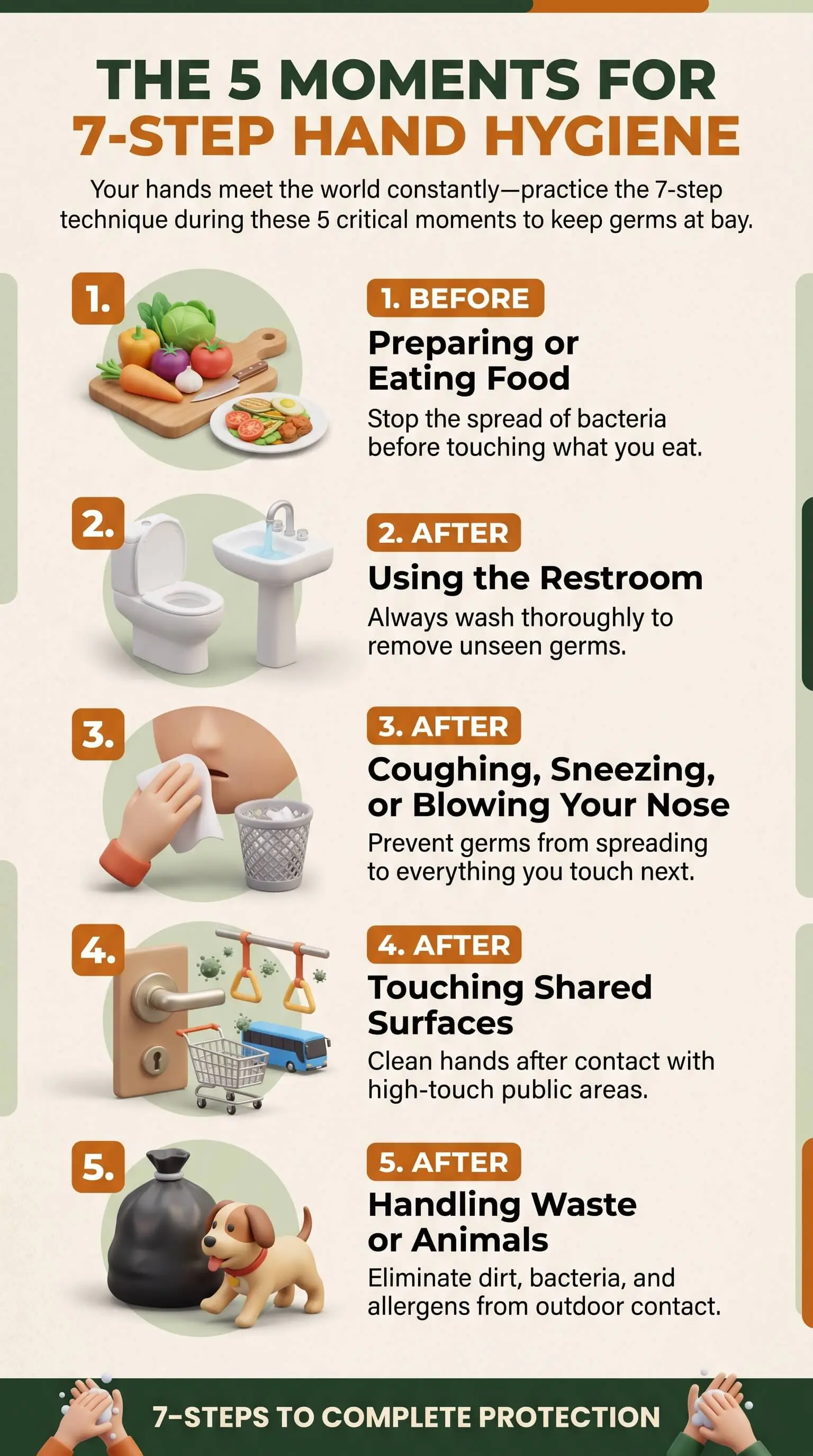
The 5 Moments That Decide Your Daily Count
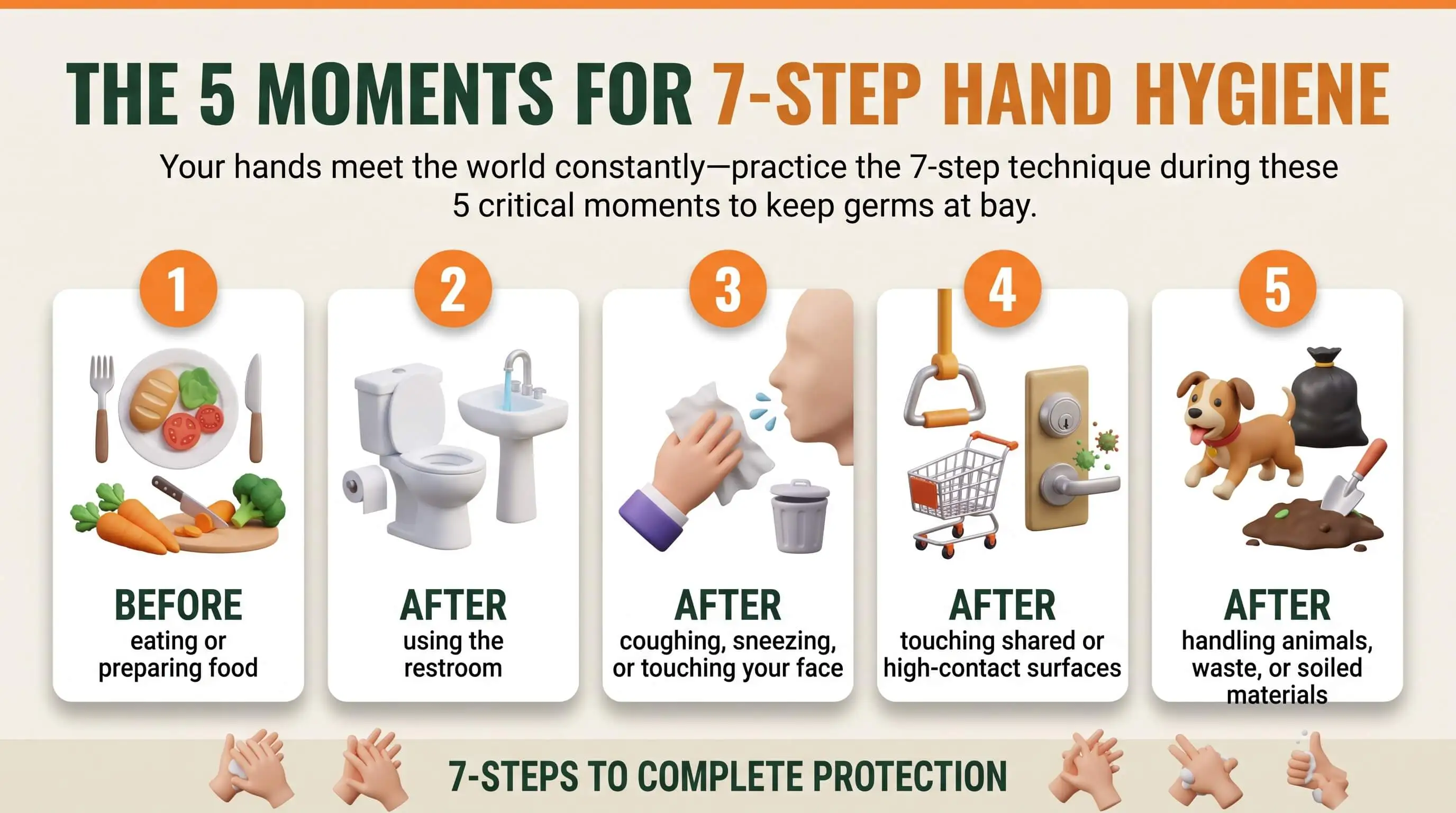
Your count isn't a quota. It's the sum of the moments your day contains. The WHO built its 5 Moments framework for hospitals, and we adapted it for family life:
Before eating or preparing food. Snack time at the playground counts.
After using the restroom. Including every diaper change.
After coughing, sneezing or touching your face. Respiratory droplets land on your hands first.
After touching shared surfaces. Grocery carts, gas pumps, transit rails, elevator buttons.
After handling animals, waste or soiled materials. The dog, the trash, the garden bed.
A typical school day touches every one of these at least once. Our own family Saturday, the one we counted, passed fifteen.
How Often by Setting
Home, weekday: 6 to 8 practices, driven by meals, restroom visits, cooking and pets
School: 5 to 7 practices, driven by arrival, recess, lunch and restroom visits
Office: 5 to 7 practices, driven by the commute, meals, restroom visits and shared kitchens
Travel and outdoors: 6 to 10 practices, driven by shared surfaces, trail meals and restrooms
Food service: often 20 or more, driven by every switch between raw food, money and surfaces
Healthcare: often 20 or more, driven by the WHO's clinical 5 Moments around each patient
These ranges reflect the moments each setting typically contains, not a target to hit. If your day holds more moments, you practice more.
How Long Each Practice Should Take
Soap and water: at least 20 seconds of scrubbing, ending after a full rinse and dry
WHO full hand wash: 40 to 60 seconds, ending after a rinse and a single-use towel
Alcohol-based hand rub: 20 to 30 seconds, ending when hands are fully dry
NOWATA rinse-free soap: all 7 steps in under 30 seconds, ending when the formula clumps and you brush it off
Need a timer? Hum "Happy Birthday" twice, or count a slow three on each step.
When There's No Sink: Practicing the 7 Steps Anywhere
This is where the daily count falls apart for most families. The intent is there. The sink isn't.
Alcohol-based sanitizer became the default fallback, but it kills germs chemically and leaves the dead germs, dirt and residue on your skin. It also works poorly on visibly soiled hands. For sensitive skin, there are gentler routes worth knowing, which is why we explored hypoallergenic hand sanitizer alternatives.
We built NOWATA for exactly this gap. You apply it to dry hands, rub through the same seven steps until the plant-based formula clumps, then brush it off. In laboratory testing, that process physically removed over 99.9% of tested virus and bacteria particles.* Same technique. No water. No rinse.
"People ask us how often they should do the seven steps, and they expect a number. We understand. We're scientists, and we wanted one too. But when we counted our own family's day, the number wasn't the lesson. The pattern was. Fifteen to twenty moments that called for clean hands, and fewer than half of them anywhere near a sink. That's when we stopped treating frequency as a willpower problem. Nobody skips step six because they don't care. They skip it because they're at the trailhead with a hungry toddler and no water, or rushing twenty-five kids through one classroom sink before lunch. As doctors, we know the technique works. As parents, we know the real question isn't how many times a day. It's whether every one of those moments gives you a way to do it right. That question is why we spent two years building NOWATA."
7 Essential Resources
We're doctors, but we're also parents who have searched "how often should I wash my hands" late at night with a sick kid down the hall. These are the seven resources we trust most on timing, technique and frequency. Each one shaped how we think about the 7-step routine.
1. WHO: Five Moments for Hand Hygiene
This is where the moment-based approach started. The World Health Organization's one-page framework shows exactly when clean hands stop germs from spreading. It was written for health care, and it's the backbone of the everyday version we use at home.
Source: World Health Organization
URL: https://www.who.int/publications/m/item/five-moments-for-hand-hygiene
2. WHO: Hand Hygiene: Why, How and When? brochure
If you want to see the technique, print this one. It illustrates every motion of the hand wash and hand rub, and it sets the timing: 40 to 60 seconds for a full wash, 20 to 30 seconds for a rub. Tape it by the sink and let it do the reminding.
Source: World Health Organization
3. CDC: About Handwashing
The plain-language guide for families. The CDC lists the key times to wash, from food prep to diaper changes to touching garbage, and walks through its 20-second method. It's the page we send to anyone who asks, "When does it actually matter?"
Source: Centers for Disease Control and Prevention
4. CDC: Handwashing Facts
The numbers behind the habit. This page explains why each part of the wash matters, including why germs concentrate under the nails, and how much illness handwashing education prevents. It's the evidence that convinces us frequency is worth the effort.
Source: Centers for Disease Control and Prevention
URL: https://www.cdc.gov/clean-hands/data-research/facts-stats/index.html
5. Wellcome Open Research: Hand Hygiene Practices and the Risk of Human Coronavirus Infections
The study behind the six-to-ten benchmark. Researchers at University College London tracked how often Flu Watch participants washed and compared it with infection rates. As scientists, we appreciate that it gives families a real number instead of the vague advice to wash "often."
Source: Beale et al., Wellcome Open Research, 2020
6. NFID: 2025 State of Handwashing Report
The most current look at how Americans actually behave. The National Foundation for Infectious Diseases surveyed 3,587 U.S. adults and found the gap between knowing and doing is wide. It confirmed what we kept seeing at playgrounds and pickup lines.
Source: National Foundation for Infectious Diseases
7. The Global Handwashing Partnership: Resource Library
For teachers, coaches and community leaders. This free library holds fact sheets, research summaries and toolkits for building handwashing habits in groups. If you're managing a classroom of kids and one sink, start here.
Source: The Global Handwashing Partnership
3 Statistics
We follow evidence. These three numbers shaped how we think about frequency, and why we built a soap for the moments a sink can't reach.
1. Washing 6 to 10 times a day was linked to a 36% lower risk of seasonal coronavirus infection
UCL researchers analyzed 1,633 participants in England's Flu Watch study. Those who washed six to ten times a day had a 36% lower risk of seasonal coronavirus infection than those who washed zero to five times. Washing more than ten times a day showed no further reduction.
What this tells us as doctors and parents:
Frequency matters, and there's a practical sweet spot
Six to ten lines up with the number of true risk moments in an ordinary day
Past that point, gentle skin care matters more than extra washes
Source: Beale et al., Wellcome Open Research, 2020
2. Handwashing education cuts diarrheal illness by 23 to 40% and respiratory illness by 16 to 21%
The CDC also reports that handwashing education reduces gastrointestinal-related school absences by 29 to 57%. Those reductions come from people washing at the right moments, consistently, not from occasional deep scrubs.
What this tells us:
Consistency at key moments is what produces the benefit
Kids gain the most when clean hands are easy to reach during the school day
Source: Centers for Disease Control and Prevention, Handwashing Facts
URL: https://www.cdc.gov/clean-hands/data-research/facts-stats/index.html
3. 48% of U.S. adults forget or choose not to wash at key moments
The 2025 NFID State of Handwashing Report surveyed 3,587 U.S. adults. Nearly half admitted skipping handwashing after visits to grocery stores, restaurants or healthcare settings. Only 30% said they were most likely to wash after coughing or sneezing.
What this tells us:
The gap isn't knowledge; 62% knew a 20-second soap-and-water wash works
The moments people skip are the ones that happen away from home and away from a sink
That's the exact gap NOWATA was designed to close
Source: National Foundation for Infectious Diseases, 2025 State of Handwashing Report
Research shows that washing hands 6 to 10 times daily is linked to a 36% lower risk of seasonal coronavirus infection, while consistent handwashing education reduces diarrheal and respiratory illnesses. Yet 48% of U.S. adults still skip washing at key moments, highlighting the importance of making hand hygiene easier and more accessible. Using natural non toxic hand soap as part of a consistent handwashing routine can help support good hygiene habits, especially when cleaning hands at the moments that matter most.
Final Thoughts and Opinion
Our honest opinion, after two years of formulation and a lot of counting at home: most people don't fall short on the 7-step technique because they're careless. They fall short because the day hands them more moments than sinks.
The science on technique has been settled for years. The WHO published its hand hygiene guidance in 2009. The CDC's 20-second rule is taught in kindergarten. And still, nearly half of U.S. adults skip washing at the moments that matter most.
What we believe
Frequency is a design problem. Telling people to wash "often" doesn't help when half their risk moments happen in a car, a park or a classroom.
Six to ten is a useful target, not a rule. Count your day's real moments. That's your number.
Every practice should be a full practice. A rushed rinse that skips thumbs and fingertips gives a false sense of cleanness.
Skin health is part of hand hygiene. If frequent washing cracks your hands, change the formula, not the habit.
Why we built NOWATA
We aren't here to replace the sink. When a sink is there, use it. We built NOWATA for the other half of the day, so the seven steps travel with you to the trailhead, the bleachers and the back seat.
Clean hands are one part of a healthier home, alongside the air you breathe. If you're working on that side too, here's what an air ionizer actually does.
Frequently Asked Questions
How many times a day should you wash your hands?
Most adults land between six and ten times a day. A UCL analysis of 1,633 Flu Watch participants linked that range to a 36% lower risk of seasonal coronavirus infection, with no extra benefit past ten.
How we think about it at home:
Don't chase a quota; count your moments
Before every meal, after every restroom visit, after every sneeze into your hands
Busy days with errands, sports or travel will run higher, and that's fine
Do you need to do all 7 steps of hand hygiene every time?
Yes. The steps aren't extras layered on top of a basic wash. They are the wash.
What gets missed when people rush:
Thumbs, because they sit apart from the other fingers
Fingertips and nails, where germs concentrate most
The backs of the fingers
A ten-second rinse that skips those zones doesn't count as a lighter version. It leaves the highest-risk areas untouched.
How long should the 7-step handwashing technique take?
At least 20 seconds of scrubbing with soap and water, per the CDC. The WHO's full hand wash runs 40 to 60 seconds, including wetting, rinsing and drying.
Our favorite timers for kids:
Hum "Happy Birthday" twice
Count a slow three on each of the seven steps
Tell them to rub like they're putting on invisible gloves
Can you use the 7 steps with hand sanitizer or waterless soap?
Yes. The WHO's hand rub uses the same motions and takes 20 to 30 seconds, until hands are dry. The catch with alcohol sanitizer: it kills germs chemically but leaves the dead germs, dirt and residue on your skin, and it works poorly on visibly dirty hands.
With NOWATA, you rub through the same seven steps on dry hands until the plant-based formula clumps, then brush it off. In laboratory testing, that physically removed over 99.9% of tested virus and bacteria particles.*
Is it possible to wash your hands too often?
It can be for your skin. In the UCL data, washing more than ten times a day added no measurable protection, while frequent surfactant exposure can dry and crack the skin barrier.
If you need to wash a lot, for work or a new baby:
Choose a gentle, sulfate-free formula
Use lukewarm water, not hot
Moisturize at least once a day, as the WHO recommends
Make Every Hand Hygiene Moment Count
You know the 7-step handwashing technique and how often to practice it. Now make it possible wherever your day goes.
Tuck a tube of NOWATA in the car console, the diaper bag, the hiking pack and your kids' backpacks. Apply, rub through all seven steps until it clumps, brush off. Clean hands in under 30 seconds, sink or no sink.
For the full doctor-made walkthrough, see NOWATA's guide to the 5 moments and 7 steps of hand hygiene, then shop NOWATA and give your family a clean that works with or without water.