You squeeze the bottle for the third time before lunch and your hands start telling you to stop. The skin around your knuckles has gone tight and white. There is a hairline split next to your thumbnail that was not there yesterday. By the end of the workweek, your hands look like they belong to someone twenty years older than you.
If that is you, the standard alcohol gel is not your only option. A good hand sanitizer alternative built for sensitive skin, with the fragrance left out, can give you the germ protection you need without the daily damage to your hands.
I have spent years writing about indoor air quality, and the same homes where people complain about reactive sinuses tend to be the same homes where someone has a half-used bottle of sanitizer they cannot stand to use. The skin barrier and the respiratory barrier are downstream of the same problem: too many irritants, too little recovery time. This page is the hand-care half of that conversation.
TL;DR Quick Answers
What Is the Best Hand Sanitizer Alternative for Sensitive Skin?
• The best hand sanitizer alternative for sensitive skin is a fragrance-free formula that contains at least 60% alcohol along with glycerin or aloe to protect the skin barrier.
• For people who react to alcohol itself, alcohol-free formulations using benzalkonium chloride work for low-risk daily moments but are weaker against most germs.
• Waterless cleansing soaps offer a third option that cleans the hands the way regular soap does, without needing a sink and without causing alcohol sting.
• A barrier moisturizer applied within sixty seconds of any hand-cleansing product matters more for long-term skin health than which cleanser you pick.
• "Hypoallergenic" is a marketing term with no FDA standard behind it, so always read the ingredient list rather than relying on the front label.
Top Takeaways
• "Hypoallergenic" is a marketing term and not a regulated standard, so always read the full ingredient list rather than relying on the front of the bottle.
• Added fragrance is the single most common avoidable trigger in standard hand sanitizers. Removing it eliminates the largest source of reactivity for most people.
• Alcohol-free sanitizers are gentler on the skin but noticeably weaker against many germs. Use them for low-risk moments and rotate to alcohol gels when actual disinfection matters.
• Waterless cleansing soaps are the under-used third option that combines soap-style physical cleansing with the portability of a sanitizer bottle.
• A barrier moisturizer applied within sixty seconds of any hand-cleansing product matters more for long-term skin health than which cleanser you choose.
What "Hypoallergenic" Actually Means on a Hand Sanitizer Label
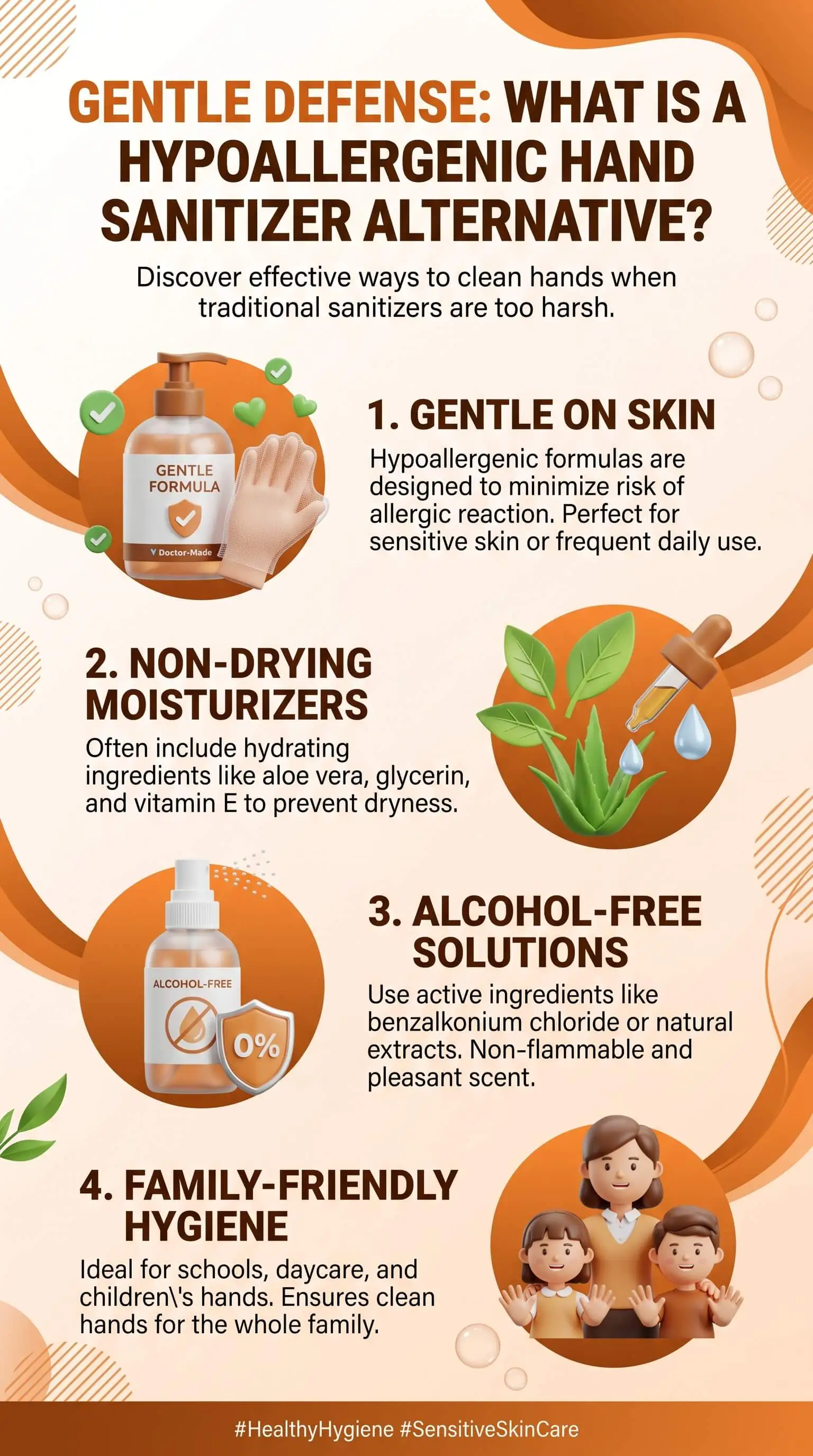
The word does not carry much regulatory weight in the United States. The FDA does not define "hypoallergenic" for over-the-counter drugs the way it defines the active ingredient percentage or the warning text. A brand can print the word on the bottle without proving anything specific about reactivity rates. That puts the work back on you, the person reading the ingredient list.
What you are really looking for is a short ingredient list, no added fragrance, no dyes, and a humectant or emollient like glycerin, aloe, or dimethicone for skin barrier protection. If those four boxes are checked, the bottle is operating in the spirit of the term whether or not it prints the word on the front.
From there, three product categories cover almost every real-world need a sensitive-skin user has.
Category 1: Fragrance-Free, Low-Alcohol Gels with Humectants
This is the gentlest form of conventional sanitizer and the easiest swap for most people. The alcohol still does the germ-killing work and the CDC asks for at least 60%, but the formula leaves out the fragrance compounds that cause the bulk of allergic reactions, and it adds glycerin or aloe to hold moisture in the skin.
According to the Wikipedia entry on hand sanitizer, alcohol-based formulations that include emollients have caused noticeably less skin irritation in clinical trials than soap and water washing. Alcohol is not the villain most people assume it is. The fragrance and the missing humectants are.
If you only change one thing about your hand-care routine, change to a fragrance-free version of what you are already using. That single move removes the largest avoidable trigger.
Category 2: Alcohol-Free Formulations with Benzalkonium Chloride
For people whose reaction is to the alcohol itself rather than the additives, alcohol-free formulations exist. These usually rely on benzalkonium chloride or a related quaternary ammonium compound. They sit on the skin gently. They do not sting an open hangnail. And they are noticeably weaker against many of the germs you actually care about.
The CDC and the FDA both recommend alcohol-based options as the first choice for a reason: alcohol-free versions reduce microbial growth rather than killing germs outright. For a parent wiping a toddler's hands at the playground, that may be the right tradeoff. For a healthcare worker between rooms, it is not. Match the product to the risk level of the moment instead of treating one bottle as your only tool.
Category 3: Waterless Cleansing Soaps and Rinse-Free Hand Washes
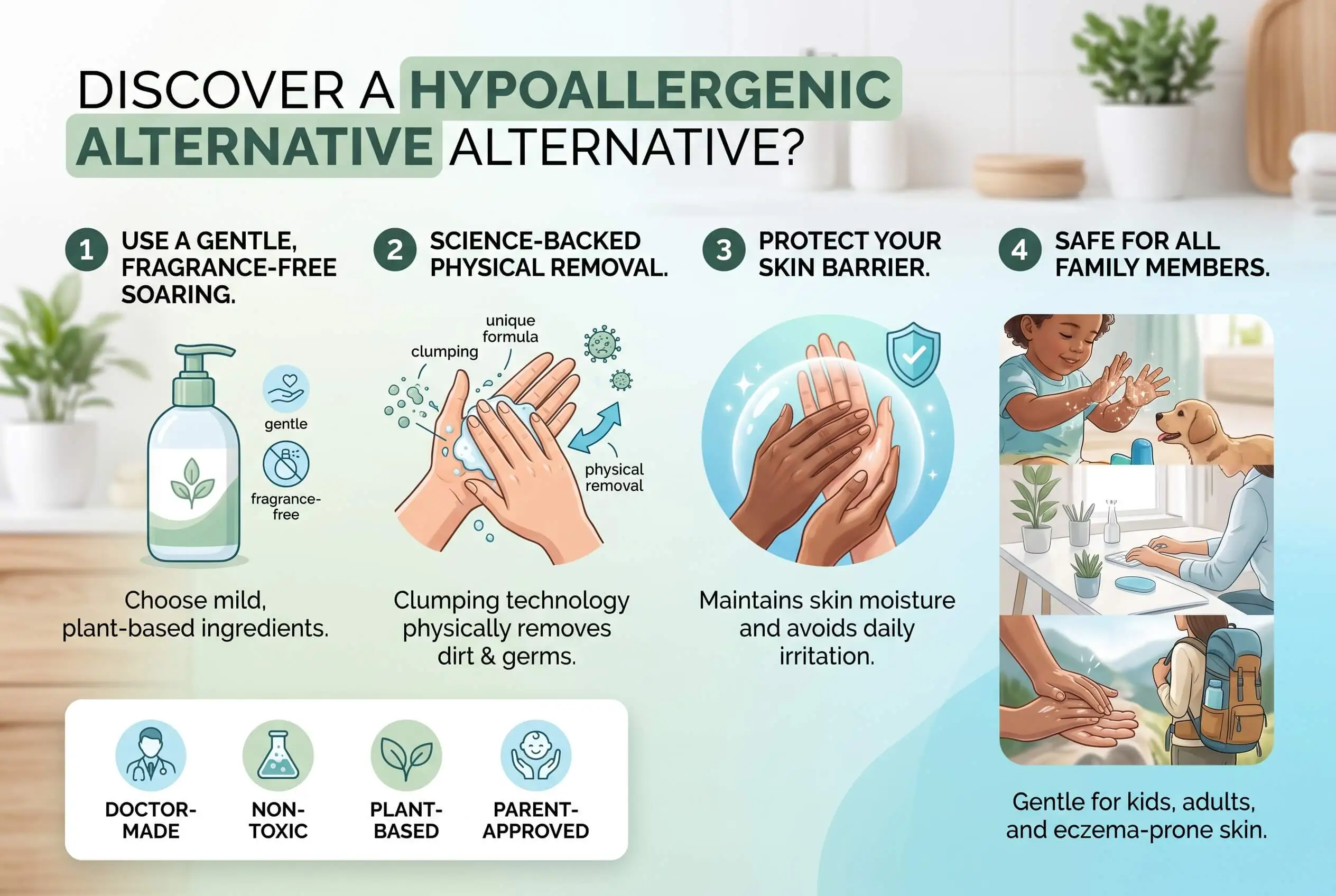
This is the category most readers do not know exists, and it is the one I have recommended most often to people with severe reactivity. A waterless cleansing soap behaves the way regular soap does. It lifts dirt, oil, and germs off your skin through surfactants. The difference is that it does not need a sink. You apply it, rub it in, and wipe it off with a towel or a paper towel.
There is no alcohol burn. There is no fragrance load. The cleansing happens through physical removal rather than chemical disinfection, which is the same mechanism dermatologists prefer when they are managing a flared hand. For someone who has developed a real skin reaction to standard sanitizer, this category often becomes the daily default, with a fragrance-free alcohol gel held in reserve for moments when actual disinfection genuinely matters.
“After fifteen years of helping homeowners deal with reactive sinuses, sensitive eyes, and stubborn allergy flares, I have noticed the pattern most people miss. The same household that needs an air purifier almost always has someone whose hands react to standard sanitizer. The skin and the airway are both barriers, and both get overwhelmed by the same kinds of synthetic fragrance and harsh additives. When I tell a reader to switch their sanitizer, I am rarely solving a hand problem in isolation. I am closing one of three or four doors that have been quietly letting irritants into the same person's life.”
7 Essential Resources
Each of these has been my go-to for grounding what I write in real medical guidance rather than product marketing. Bookmark the ones that match your situation.
• CDC Hand Sanitizer Facts — The clearest plain-English breakdown of when sanitizer works, when it does not, and why the 60% alcohol minimum exists.
• CDC Hand Sanitizer Use Guidelines — Step-by-step guidance for getting the most out of whichever product you choose, including the moments when soap and water beats sanitizer outright.
• CDC Safe Healthcare Blog: Keeping Hands Clean and Healthy — Written by practicing dermatologists, this is the best read for anyone who already has hand dermatitis and needs a treatment-and-prevention plan.
• FDA: Safely Using Hand Sanitizer — The official safety guidance plus the FDA's ongoing list of recalled and unsafe sanitizer products you should not have in your home.
• WHO Guidelines on Hand Hygiene: Skin Reactions Chapter — The most thorough single resource on why hand hygiene products cause irritation and what reduces that risk in clinical and home settings.
• American Academy of Dermatology: Eczema Resource Center — Patient-facing guidance from board-certified dermatologists on managing eczema-prone skin, including the daily product choices that matter most.
• Mayo Clinic: Contact Dermatitis Symptoms and Causes — A clear diagnostic walkthrough that helps you tell whether your hands are reacting to a true allergy, an irritant, or simple over-cleansing.
3 Statistics
Hand dermatitis was reported as the second most common nonfatal occupational illness in 2020, according to dermatologists writing for the CDC Safe Healthcare Blog. The numbers reflect an enormous swing tied to pandemic-era hand hygiene routines, and they have not fully reset.
A cross-sectional study of 270 healthcare workers found that 82.6% reported irritant contact dermatitis symptoms during the early months of the COVID-19 response, with the hands as the most affected site at 76.47% of cases. The full data is published on PubMed Central.
WHO's synthesis of nursing studies puts irritant contact dermatitis prevalence at 25% to 55%, with as many as 85% of nurses reporting a history of skin trouble linked to repeated hand hygiene product exposure. The full review sits in the WHO Guidelines on Hand Hygiene in Health Care. Whatever your job is, those numbers are a useful reality check.
Final Thoughts
Here is where I land after years of writing about this. For most sensitive-skin readers, the right move is not finding one perfect product. It is building a small rotation: a fragrance-free, low-alcohol gel for the high-risk moments, a waterless cleansing soap for routine daily use, and a barrier moisturizer applied within sixty seconds of either product.
High-risk moments mean things like getting off public transit, eating with your hands, or being near someone visibly sick. Routine daily use covers everything else: handling your phone after meetings, getting in and out of the car, touching shared doorknobs and elevator buttons. Most people use the wrong product for the wrong moment, then blame their skin for the consequences.
The waterless soap category is the one most readers have not tried, and it is the one I get the most thank-you notes about. Companies like Nowata make a waterless cleansing soap that works as a hand sanitizer alternative without the alcohol sting or the added fragrance load. That is exactly the kind of formulation I keep recommending to readers whose skin can no longer take another round of conventional gel.
My honest opinion: most of what people call "sensitive skin" is actually a skin barrier that has been worn down by ten years of fragranced products and three years of pandemic-level sanitizer use. The skin will recover. But it needs you to stop hitting it with the same thing that broke it. The alternatives in this guide are the off-ramp.
Frequently Asked Questions
What is the best hand sanitizer alternative for sensitive skin?
For most people, the best option is a fragrance-free alcohol gel containing at least 60% alcohol along with glycerin or aloe to protect the skin barrier. If you have reacted to alcohol itself, a benzalkonium chloride formulation works for low-risk moments, and waterless cleansing soaps cover daily use without the burn. The right answer depends on how much actual disinfection your day requires.
Are alcohol-free hand sanitizers actually effective?
They reduce the number of germs on your hands but do not kill them outright the way alcohol does. The CDC and FDA recommend alcohol-based products as the first line because of that gap. Alcohol-free options are reasonable for low-risk moments like wiping a toddler's hands at the park or freshening up between errands. They should not be your only product if you are around sick people regularly.
What ingredients in hand sanitizer cause skin irritation?
Fragrance compounds top the list. They are the single largest cause of allergic contact dermatitis from personal care products in general. After fragrance come dyes, certain preservatives, and high-concentration alcohol used without humectants. People with eczema or atopic dermatitis tend to react to all of these more strongly because their skin barrier already lets more irritants through.
Can I use soap and water instead of hand sanitizer if I have eczema?
Yes, and the CDC actually recommends it whenever a sink is available. Soap and water removes more types of germs than sanitizer does, including a few that alcohol cannot kill. The catch for eczema-prone hands is choosing a fragrance-free, sulfate-free soap and following with a thick moisturizer right away. Done that way, soap and water tends to be gentler over time than repeat sanitizer use.
Is fragrance-free hand sanitizer the same as hypoallergenic hand sanitizer?
Almost, but not quite. "Fragrance-free" is a specific claim that means no added fragrance compounds in the formula. "Hypoallergenic" is a marketing term with no enforced FDA standard, so a hypoallergenic-labeled product might still contain dyes, certain preservatives, or other reactive ingredients. A truly low-allergy product is fragrance-free and dye-free with a short ingredient list, regardless of which word appears on the label.
What is a waterless soap and how does it work?
Waterless soap is a cleanser that lifts dirt, oil, and germs off your skin through surfactants rather than alcohol-based disinfection, and it does not need a sink to rinse. You apply it, rub it in, then wipe it off with a towel or cloth. The result is closer to washing your hands than to sanitizing them, with the portability of a sanitizer bottle. It is a fit for people whose skin cannot tolerate repeated alcohol exposure.
Are foam hand sanitizers gentler than gels?
Sometimes, but the format matters less than the formula. A foam version of a fragranced, high-alcohol product will still strip your skin. A gel version of a fragrance-free, low-alcohol formula with glycerin will treat your hands well. Read the ingredient list before you focus on the format. That said, foams tend to spread more evenly with less product, which can mean less concentrated alcohol in any one spot.
How often is it to use hand sanitizer on sensitive skin?
There is no universal number, but the dermatology research points to trouble starting around ten uses per day for people with intact skin and much earlier for people with eczema or existing irritation. If your hands are dry, red, or stinging by mid-afternoon, you are past your personal limit. The fix is to swap some of those uses for waterless soap or soap and water, and to layer on a barrier moisturizer.
Ready to Try a Gentler Approach?
If your hands have been quietly telling you something is wrong with your current sanitizer, the next step is the easiest swap in your routine. Try one fragrance-free alternative for two weeks and watch what happens to the redness around your knuckles.
While you are paying attention to what is irritating you, start with whether a sulfate free hand soap is helping reduce dryness, tightness, or repeated skin irritation. The rest of this site has more on the same theme. Read up on what you are breathing, what is growing in the indoor air around you, and what else in a typical home is quietly working against the people who live there. Hand care does not solve the problem alone, but it is the easiest place to start.
Have a question, a product worth checking out, or a story about what worked for your skin? Leave a comment below. I read every one of them.