Here's what most HVAC shoppers don't hear until it's too late: standard efficiency ratings are tested in controlled conditions. Deltona's humidity doesn't care about controlled conditions. It pushes through ductwork, overwhelms undersized equipment, and turns a system that looked perfect on paper into one that runs constantly without ever making the house feel comfortable. The system was selected for cooling capacity. Nobody accounted for the humidity load.
What this page covers:
Why standard efficiency ratings don't tell the full story in Florida's climate.
Which equipment features genuinely improve indoor humidity — and which are marketing language.
How proper sizing and installation determine whether humidity control works at all.
What to ask any contractor before committing to a replacement in this market.
If your home feels muggy with the AC running, the temperature usually isn't the problem. In Deltona, it's almost always the humidity — and the system either wasn't built to handle it or wasn't installed to deliver what it promised. We've diagnosed that exact scenario in more Volusia County homes than we can count, which is why top HVAC system replacement near Deltona FL has become the priority solution homeowners trust to restore proper comfort and humidity control. This page explains how to avoid it.
TL;DR Quick Answers
Top HVAC System Replacement Near Deltona, FL
Finding the best HVAC replacement for humidity control in Deltona comes down to three things: the right system, the right installation, and a contractor who understands Florida's climate — not just its temperature. Here's what Deltona homeowners need to know:
Best system for Deltona's humidity: Variable-speed equipment with a dedicated dehumidification mode, matched to your home's specific cooling and humidity load via Manual J calculation — not square footage.
Why humidity fails even with a new system: Oversized equipment, single-stage operation, incorrect refrigerant charge, or leaky ductwork. Any one of these undermines humidity control regardless of equipment quality.
What installation must include: Refrigerant verification, airflow commissioning, duct sealing, and AHRI-certified matched components. These steps are non-negotiable in Florida's climate.
The EPA standard to know: Indoor relative humidity should stay between 30% and 50%. Consistently above 55–60% with the AC running means the system isn't managing the moisture load — not just the temperature.
Installation faults matter: DOE research confirms faults can increase energy use by up to 30%. In Deltona, where systems run most of the year, that inefficiency compounds on every utility bill.
Verify your contractor: Florida law requires a valid state HVAC license. Check any contractor at myfloridalicense.com before scheduling.
Start with a free estimate: A proper in-home assessment — including a Manual J load calculation — is the most important step toward a system that actually controls humidity in Deltona's climate.
Top Takeaways
Humidity control in Deltona is a process — not a product.
Correct system selection, proper installation, and full commissioning are all required.
Skipping any one step creates a problem the equipment alone can't fix.
Oversizing is the most common and most costly mistake we see in Volusia County.
Oversized systems cool quickly, short-cycle, and never dehumidify properly.
The home hits target temperature and still feels humid.
The equipment gets blamed. The estimate was the actual problem.
Modern AC systems are built to cool air — not remove moisture equally well.
The U.S. Department of Energy confirms: standard systems are far more effective at reducing temperature than extracting humidity.
The solution: variable-speed equipment with a dedicated dehumidification mode, commissioned for Florida's latent load.
Installation faults can increase energy use by up to 30% — silently, for the life of the system.
DOE research confirms: incorrect refrigerant charge, improper airflow, and duct leakage compound over time.
In Deltona, where systems run most of the year, that inefficiency appears on every utility bill.
One third of all structures have damp conditions that put indoor air quality at risk.
Per the EPA, contaminated air handling systems can spread mold and biological pollutants throughout a home.
A properly sized, correctly installed, and consistently maintained system is not just a comfort upgrade in Florida's climate.
It's a healthy decision.
Why Humidity Is a Different Problem Than Heat in Deltona
Most homeowners think about HVAC performance in terms of temperature. In Deltona, that's only half the equation.
Florida's humidity doesn't just make the air feel warmer — it forces your HVAC system to work on two separate jobs simultaneously: cooling the air and removing moisture from it. When a system is sized or installed without accounting for that dual demand, it short-cycles. It reaches the target temperature quickly, shuts off, and never runs long enough to pull meaningful moisture out of the air. The house hits 74 degrees and still feels like 80 — a challenge that professional HVAC replacement service can solve by ensuring the system is properly sized and optimized for Florida’s climate.
What we see consistently in Volusia County homes:
Oversized systems that cool too fast and dehumidify too little.
Single-stage equipment that blasts at full capacity instead of running longer at lower output.
Ductwork with enough leakage to reintroduce unconditioned humid air back into the supply stream.
Humidity control isn't a bonus feature in Deltona's climate. It's the baseline requirement.
What to Actually Look for in a System Built for Florida Humidity
Not all high-efficiency systems handle humidity equally. In our experience installing and servicing equipment across Volusia County, these are the features that make a measurable difference in homes like yours:
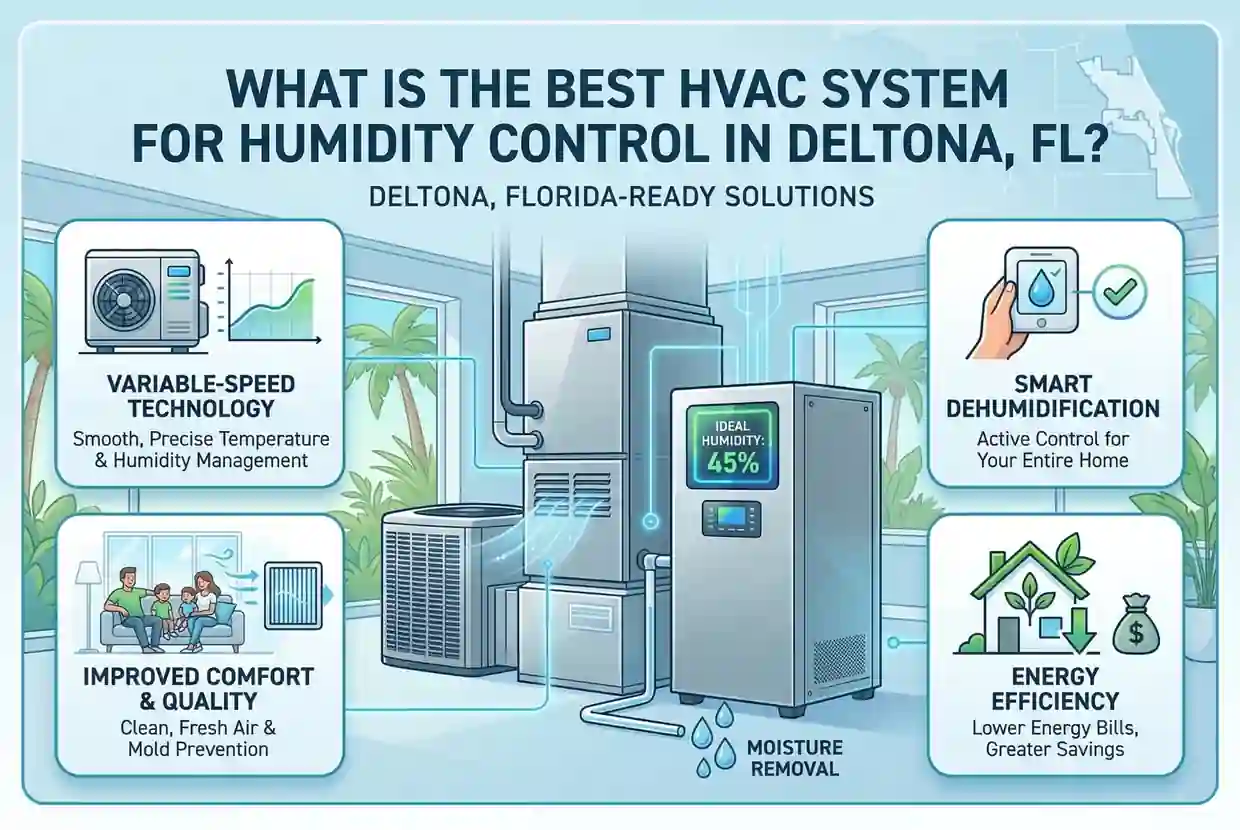
Variable-speed air handlers. Single-stage systems operate at one speed: full blast. Variable-speed systems modulate output — running longer at lower capacity, which dramatically increases moisture removal from the air. In Deltona's climate, this is the single most impactful equipment feature for indoor comfort and works even better when paired with air purifiers for cleaner, healthier indoor air.
Two-stage or variable-speed compressors. Paired with a variable-speed air handler, a two-stage or variable-speed compressor allows the system to match output to actual demand. Less short-cycling. More dehumidification. Lower utility bills.
A high-efficiency dehumidification mode. Some systems include a dedicated dehumidification setting that further reduces airflow across the coil — extracting more moisture per cycle without dropping the temperature below the set point. In homes where occupants frequently feel cool but clammy, this feature changes the daily comfort experience.
Properly matched AHRI-certified components. An indoor coil and outdoor unit that aren't certified as a matched system don't perform to rated specifications — including humidity removal capacity. Every system we install in Deltona leaves with AHRI documentation confirming the match.
Why System Sizing Matters More in Humid Climates
Bigger isn't better when it comes to HVAC systems in Florida. It's one of the most persistent misconceptions we encounter — and one of the most costly.
An oversized system in Deltona's climate:
Reaches set-point temperature quickly and shuts off before completing a full dehumidification cycle.
Creates temperature swings that feel uncomfortable even at the correct thermostat reading.
Runs more frequent on/off cycles, accelerating wear on components.
Leaves relative indoor humidity consistently higher than it should be.
Correct sizing starts with a Manual J load calculation — a room-by-room analysis of your home's specific heat and moisture load based on square footage, insulation levels, window placement, duct condition, and local climate data. It's the only way to select a system that actually matches what your home demands. It's the first thing we do at every free estimate in Volusia County.
How Installation Quality Determines Whether Humidity Control Works at All
A properly specified system installed incorrectly still fails to control humidity. This is where most homeowners get the worst surprises — and where top HVAC replacement near me becomes the priority for correcting other contractors' work, which is something we spend a significant amount of time addressing.
The installation factors that directly impact humidity performance:
Refrigerant charge. An undercharged or overcharged system loses moisture removal capacity. U.S. Department of Energy research confirms that incorrect refrigerant charge is one of the most common — and most impactful — installation faults in residential HVAC.
Airflow across the coil. Too much airflow reduces moisture removal. Too little reduces cooling capacity. Proper commissioning verifies the balance is correct for your specific equipment and home.
Duct condition and sealing. Leaky ductwork in a humid Florida attic reintroduces warm, moist air into the supply stream — directly undermining whatever dehumidification the equipment just performed.
Thermostat placement and programming. A thermostat positioned near a supply vent or in direct sunlight gives the system inaccurate readings, disrupting run cycles and reducing dehumidification time.
The Air Filter Connection Most Homeowners Miss
There's one more factor that affects humidity control that rarely comes up in a contractor conversation — and it's something we understand from the manufacturing side as well as the service side.
A clogged or incorrect air filter restricts airflow across the evaporator coil. Restricted airflow means the coil can't absorb heat and moisture efficiently. The system works harder, runs less effectively, and removes less humidity per cycle — even if the equipment itself is perfectly sized and installed.
In Deltona's climate, where systems run hard for most of the year, filter maintenance isn't optional. A high-quality filter changed on schedule keeps airflow at the rate the system was commissioned to deliver. It's the lowest-cost, highest-return maintenance step available to any Deltona homeowner — and one that directly supports the humidity control performance the rest of the system was designed to provide.
"Deltona homeowners ask us all the time why their home still feels humid even with a brand-new system running. Nine times out of ten, the answer isn't the equipment — it's everything that happened before and during installation. We've walked through hundreds of homes across Volusia County where a perfectly good system was let down by an oversized unit that short-cycles, a refrigerant charge nobody verified, or ductwork pulling humid attic air straight back into the supply stream. In Florida's climate, humidity control isn't something a system does automatically. It's something a properly sized, correctly installed, and consistently maintained system earns — one commissioning step at a time. That's the standard we hold every job to, because we've seen firsthand what happens to the homes where someone skipped those steps."
Essential Resources
Picking the right system for Deltona's humidity isn't something we'd leave to a sales pitch and a spec sheet. After years of diagnosing underperforming systems across Volusia County, the homeowners who make the best decisions are the ones who understand the problem before they start comparing equipment. These are the resources we'd hand to any neighbor before that conversation begins.
1. Start Here: Why Humidity Demands a Different Engineering Approach Than Cooling
Most homeowners don't realize that cooling air and removing moisture are two separate jobs — and standard AC systems are far better at one than the other. This DOE research explains why hot-humid climates like Deltona's require specific equipment configurations and control settings that go well beyond what a typical installation delivers. Advanced HVAC Humidity Control for Hot-Humid Climates — U.S. Department of Energy
2. Know the Humidity Thresholds That Keep Your Family Safe and Your Home Intact
The EPA is clear: indoor relative humidity should stay between 30% and 50%. Above 60%, conditions favor mold growth, biological pollutants, and air quality problems that affect both health and home structure. In Deltona, we've walked into homes where the AC was running constantly and humidity was still sitting well above that threshold — because the system was never set up to handle the moisture load. A Brief Guide to Mold, Moisture and Your Home — U.S. Environmental Protection Agency
3. Understand What Federal Humidity Performance Standards Actually Require
ENERGY STAR certification confirms baseline efficiency — but in our experience, not all certified systems perform equally in Florida's climate. This resource explains what whole-home humidity performance actually demands and how to evaluate whether a system is genuinely built for Central Florida's moisture load — not just optimized for drier test conditions. Dehumidifiers & Whole-Home Humidity Control — ENERGY STAR
4. Use This Checklist to Hold Any Contractor Accountable Before the Work Starts
A properly specified system installed without verifying refrigerant charge, airflow, and duct sealing doesn't control humidity — it just runs. This EPA-backed hiring checklist covers every installation step that determines whether a system delivers on its humidity control promises. We run through every item on this list on every job we do in Deltona. 10 Tips for Hiring a Heating and Cooling Contractor — ENERGY STAR
5. See the Research That Explains Why Variable-Speed Systems Outperform in Humid Climates
Lower airflow settings and modified control configurations dramatically improve moisture removal — and this DOE project details exactly why. It's the research that informs every variable-speed system recommendation we make to Deltona homeowners, and the reason we don't treat enhanced dehumidification modes as optional features in this market. Advanced HVAC Equipment Design Strategies for Optimal Efficiency and Humidity Control — U.S. Department of Energy
6. Understand What Uncontrolled Humidity Actually Does to Your Family's Air
High indoor humidity doesn't just make a home feel uncomfortable — it creates the conditions for mold, dust mites, bacteria, and biological pollutants that affect the air your family breathes every day. The EPA's resource on biological pollutants connects humidity performance directly to family health. It's a resource we share with Deltona homeowners who are weighing whether a replacement is worth it — because in Florida's climate, that question isn't just about comfort. Biological Pollutants' Impact on Indoor Air Quality — U.S. Environmental Protection Agency
7. Verify Every Contractor's License Before You Let Anyone Through Your Door
Florida law requires every HVAC contractor to hold a valid state license — and this check takes less than two minutes. We remind every Deltona homeowner to run it on any contractor they're considering, including us. A contractor who won't pass this check shouldn't be making decisions about the system responsible for your family's indoor air quality. HVAC Contractor License Verification — Florida Department of Business and Professional Regulation
Supporting Statistics
After years of walking through Deltona homes where the AC was running and the house still felt wrong, we stopped being surprised by what the data confirms. Here's what the research says — and what we see it looks like in real homes across Volusia County.
1. One-third of all structures have damp conditions that create serious indoor air quality risks — and the HVAC system is the primary line of defense.
The EPA confirms that one third of all structures have damp conditions that may encourage mold, bacteria, and biological pollutants — including conditions that trigger asthma and spread infectious diseases.
Contaminated central air handling systems can become breeding grounds for mold and mildew — then distribute those contaminants throughout the entire home, per the EPA.
In Deltona's climate, that risk doesn't take a season off.
We've walked into homes where the system was running on schedule and indoor air quality had quietly deteriorated — because the equipment was never sized to manage the actual moisture load.
In Florida, the HVAC system is the primary moisture management tool protecting the structure and the people inside it.
Source: Biological Pollutants' Impact on Indoor Air Quality — U.S. Environmental Protection Agency
2. Oversized air conditioners are a leading cause of humidity failure in hot-humid climates — and one of the most common patterns we diagnose across Volusia County.
The U.S. Department of Energy identifies the core problem: oversized systems cool air quickly, then cycle off before completing a proper dehumidification cycle.
Even correctly sized equipment may struggle with humidity in extremely humid climates without variable capacity capability, per the DOE.
What we see in Deltona: contractors who sized up "to be safe" created humidity problems that didn't exist before the new system went in.
The fix isn't more capacity. It's correctly matched, variable-speed equipment — selected after a proper Manual J load calculation.
Source: Efficient Cooling for Hot, Humid Climates — U.S. Department of Energy
3. Heating and cooling account for 36% of all residential energy use — and installation faults can push that figure up by another 30%.
The Energy Information Administration reports that space heating and cooling account for 36% of all residential primary energy consumption.
65% of American homes rely on central air conditioners for space cooling.
DOE research estimates that installation faults can increase space conditioning energy use by up to 30%.
In Deltona, where systems run most of the year, that 30% means:
Hundreds of dollars in avoidable utility costs — paid monthly.
Compounding inefficiency over the entire lifespan of the system.
Humidity performance that never reaches what the equipment was rated to deliver.
Refrigerant verification, airflow testing, and duct sealing are non-negotiable steps on every job we do. They're what separate a system that performs from one that quietly costs money for years.
4. Modern AC systems cool air effectively — but are not built to remove moisture with equal effectiveness, making proper system selection the deciding factor in humid climates.
The U.S. Department of Energy states it directly: modern AC systems are highly effective at reducing temperature, but significantly less effective at removing moisture.
The result: homeowners lower the thermostat, run the system longer, and still feel cold and clammy.
We hear this every week in Deltona. The system is doing its primary job. It was never set up to do its second one.
Closing that gap requires three things we address at every estimate:
Variable-speed equipment with a dedicated dehumidification mode.
Commissioning that accounts for Florida's latent load — not just its cooling load.
A Manual J calculation that captures the full moisture picture of the home.
Source: Advanced HVAC Humidity Control for Hot-Humid Climates — U.S. Department of Energy
Final Thoughts
Humidity control in Deltona isn't a feature you add to an HVAC system. It's the result of getting a series of decisions right — in the right order — before a single piece of equipment gets installed, including integrating solutions like ionizers for improved indoor air quality.
The humidity problem most Deltona homeowners have isn't an equipment problem. It's a process problem.
After years of servicing homes across Volusia County, the pattern is consistent. The homes we're called into most often — where the AC runs constantly, the house never feels right, and the bills don't make sense — almost never have the wrong brand on the unit. They have:
The wrong size.
The wrong installation.
The wrong commissioning.
Sometimes all three.
What we see most consistently in Deltona:
A system selected without a Manual J load calculation — overshooting cooling capacity and short-cycling before pulling meaningful moisture from the air.
A variable-speed system installed without refrigerant verification or airflow testing — surrendering the humidity advantage the equipment was built to deliver.
Ductwork in a humid Florida attic that was never properly sealed — reintroducing the moisture the system just removed, on every cycle, for years.
None of these are equipment failures. They're process failures. In Deltona's climate, the homeowner pays for them on every utility bill until someone goes back to the beginning and does it right.
Our honest take:
Most HVAC conversations in this market start with the wrong question. Homeowners ask:
Which brand is best?
Which SEER rating do I need?
How much should I spend?
Those are reasonable — but they're third, fourth, and fifth on the list.
The right questions come first:
Will the contractor perform a real load calculation that accounts for Deltona's humidity load?
Will the installation be commissioned to the standard that makes that calculation meaningful?
Get those two things right and almost any quality equipment performs well in Florida's climate. Get them wrong and the best system on the market becomes another source of monthly frustration.
That's the standard we hold every job across Volusia County — not because it's good marketing, but because we've seen firsthand what the alternative looks like inside people's homes.
FAQ on HVAC Humidity Control Near Deltona, FL
Q: Why does my home still feel humid even with the AC running in Deltona?
A: This is the most common call we get across Volusia County. After years of diagnosing it, the answer is almost never the equipment brand. Most likely causes:
Oversized system. Cools too fast, short-cycles, shuts off before completing a dehumidification cycle.
Single-stage equipment. Runs at full capacity every cycle. Can't modulate to match humidity load.
Incorrect refrigerant charge or airflow. Both directly reduce moisture removal capacity — confirmed by DOE research and our own field diagnostics.
Leaky ductwork. Unsealed ducts pull humid attic air back into the supply stream on every cycle.
Key insight: cooling and dehumidification are two separate jobs. A system set up for only one will always leave the house feeling wrong — regardless of what the thermostat reads.
Q: What is the best HVAC system for humidity control in Deltona, FL?
A: After years of installs across Volusia County, the answer is consistent: the best system is correctly matched to your home's specific humidity and cooling load. What performs well in Deltona's climate:
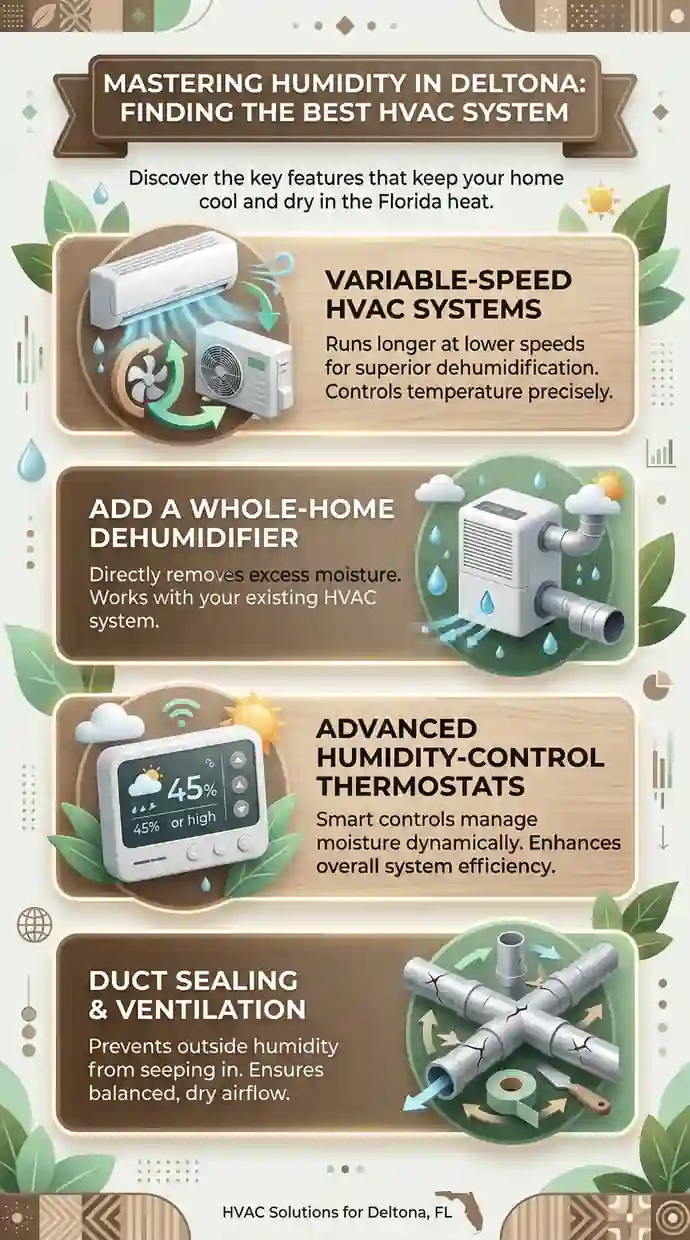
Variable-speed air handlers that run longer at lower capacity — extracting more moisture per cycle than single-stage equipment.
Two-stage or variable-speed compressors paired with variable-speed air handlers for full humidity modulation.
Systems with a dedicated enhanced dehumidification mode — critical during Florida's shoulder seasons.
AHRI-certified matched indoor and outdoor components confirmed before installation.
The equipment matters. The load calculation that determines which equipment belongs in your home matters more.
Q: How does improper HVAC installation affect humidity control in Deltona homes?
A: Significantly — and silently, for years. DOE research confirms installation faults can increase energy use by up to 30%. In Deltona's humid climate, those faults directly undermine humidity performance. Four installation factors we address on every job:
Refrigerant charge. Under or overcharged systems lose moisture removal capacity from day one. Verified with gauges — never assumed.
Airflow across the coil. Too much reduces dehumidification. Too little reduces cooling. Commissioning finds the correct balance.
Duct sealing. Leaky ducts in a humid attic reintroduce moisture the system just removed. We've seen this eliminate the humidity benefit of an otherwise perfectly installed system.
Manual J load calculation. The only accurate method for sizing to both Deltona's cooling and humidity loads. Square footage estimates don't capture Florida's moisture load.
A properly specified system installed without these steps still fails to control humidity. Most contractors in this market never have that conversation.
Q: How do I know if my HVAC system is failing to control humidity in my Deltona home?
A: The signs are consistent across Volusia County homes we service. Watch for:
Home feels muggy or clammy even when the thermostat is satisfied.
Condensation on windows, walls, or cold surfaces.
Musty or stale odors — especially near vents or in lower-traffic rooms.
Visible mold growth on walls, ceilings, or around registers.
Increased allergy or asthma symptoms indoors.
Energy bills climbing without explanation.
What to do next:
The EPA recommends keeping indoor relative humidity between 30% and 50%.
A hygrometer gives an immediate humidity reading for your home.
Consistently above 55–60% with the AC running means the system isn't managing the moisture load.
In our experience, that number tells homeowners more about their HVAC situation than any amount of guesswork.
Q: What should I ask an HVAC contractor before replacing my system for better humidity control in Deltona?
A: These are the six questions we'd want every Deltona homeowner to ask — including us:
Will you perform a Manual J load calculation — not a square footage estimate?
Will you verify refrigerant charge and airflow after installation?
Will indoor and outdoor components be AHRI-certified as a matched system?
Do you offer variable-speed equipment with an enhanced dehumidification mode?
How will you address duct leakage before or during installation?
Can you verify your Florida state license through the DBPR before we proceed?
What the answers tell you:
A contractor who answers all six clearly and in writing — before asking you to sign — is worth trusting.
A contractor who moves past any of them is telling you something important about how the job will go.
We'd rather a homeowner walk away from us over a question we couldn't answer than move forward without asking it.
Managing indoor moisture in Central Florida requires more than just lowering the thermostat. The guide What Is the Best HVAC System for Humidity Control in Deltona, FL? explains how proper system sizing, variable-speed equipment, and strong airflow management help remove excess humidity while keeping homes comfortable. One often overlooked factor is filtration, which supports steady airflow and efficient HVAC performance. For example, using 15x20x1 pleated furnace air filters helps capture dust and airborne particles that can restrict airflow and reduce system efficiency. Likewise, 20x25x2 MERV 8 HVAC furnace air filters provide balanced filtration and airflow, helping HVAC systems run long enough to remove humidity effectively. Homeowners can also consider replacement HVAC furnace air filters to maintain system performance between maintenance visits. Keeping filtration up to date complements the strategies discussed in the article and helps Deltona homeowners achieve better humidity control and overall indoor comfort.