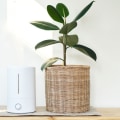
Not every houseplant belongs in an allergy-friendly home. Some release pollen, mold spores, or volatile organic compounds that make symptoms worse — not better. This page cuts through the confusion. You'll find the best hypoallergenic, air purifying plants that actively filter indoor pollutants without triggering your symptoms, plus guidance on pairing them with proper air filtration for a genuinely cleaner breathing environment.
TL;DR Quick Answers
Air Purifying Plants
Air purifying plants absorb indoor gaseous pollutants — including formaldehyde, benzene, and volatile organic compounds (VOCs) — through their leaves and root systems. The best options for allergy-sensitive households are hypoallergenic species that produce no airborne pollen and pose no mold risk under normal care. Top choices include:
Peace lily — absorbs formaldehyde, benzene, and carbon monoxide
Snake plant — converts CO2 to oxygen overnight; low maintenance
Spider plant — non-toxic, pet-safe, exceptional VOC absorber
Areca palm — natural humidifier; filters xylene and toluene
Bamboo palm — best-in-class formaldehyde removal; safe for pets
Key facts to know:
Plants work on a timescale of hours — not minutes
They absorb gases; they do not capture fine particulate matter or biological allergens
Overwatered plants breed mold, which worsens allergy symptoms
NASA recommends one to two medium plants per 100 square feet
Plants work best paired with a MERV 11 or higher air filter — together they cover the full spectrum of indoor air threats
Top Takeaways
Not all houseplants are safe for allergy sufferers. Wrong species release pollen, harbor mold, or off-gas compounds that worsen symptoms. Choosing hypoallergenic plants — and maintaining them correctly — is what separates a helpful plant from a hidden trigger.
Plants and air filters solve different problems. Plants absorb VOCs and gaseous pollutants that filters can't capture. Filters capture fine particulate matter, pet dander, and mold spores that plants can't touch fast enough. Neither replaces the other — both are essential.
Your biggest pollution source is inside your home. The EPA confirms indoor pollutant concentrations run 2 to 5 times higher than outdoors — sometimes up to 10 times higher for VOCs. Building materials, cleaning products, and furnishings generate the invisible burden your family breathes every day.
82 million Americans are diagnosed with seasonal allergic rhinitis. Nearly 1 in 3 adults manages some form of allergic condition. Indoor air quality is a whole-home priority — not a seasonal inconvenience.
A layered approach is the only approach that works. After serving more than two million households, the pattern is consistent:
Choose the right hypoallergenic plants
Pair them with a high-performance MERV-rated filter
Maintain both consistently
Little effort. Meaningful, lasting impact.
What Makes a Plant Hypoallergenic?
The term "hypoallergenic plant" gets used loosely — but it has a specific meaning worth understanding before you start filling your home with greenery. A truly hypoallergenic plant produces little to no airborne pollen, meaning it won't contribute to the sneezing, itchy eyes, and congestion that airborne allergens trigger. Many of the plants marketed as "air purifying" are actually pollinating species that can make allergy symptoms worse indoors, where pollen has nowhere to go.
The plants worth your attention share three key traits:
They reproduce through insect pollination, not wind — so their pollen is heavy and sticky, not airborne
They don't release mold spores in normal household conditions
They absorb gaseous pollutants like formaldehyde, benzene, and xylene through their leaves and root systems
That third point matters more than most allergy guides acknowledge. Volatile organic compounds (VOCs) from household products — paints, cleaning supplies, synthetic textiles — are a major but invisible driver of indoor allergy-like symptoms. Certain plants help capture and neutralize them at the source.
The Best Hypoallergenic Air-Purifying Plants for Allergy Sufferers
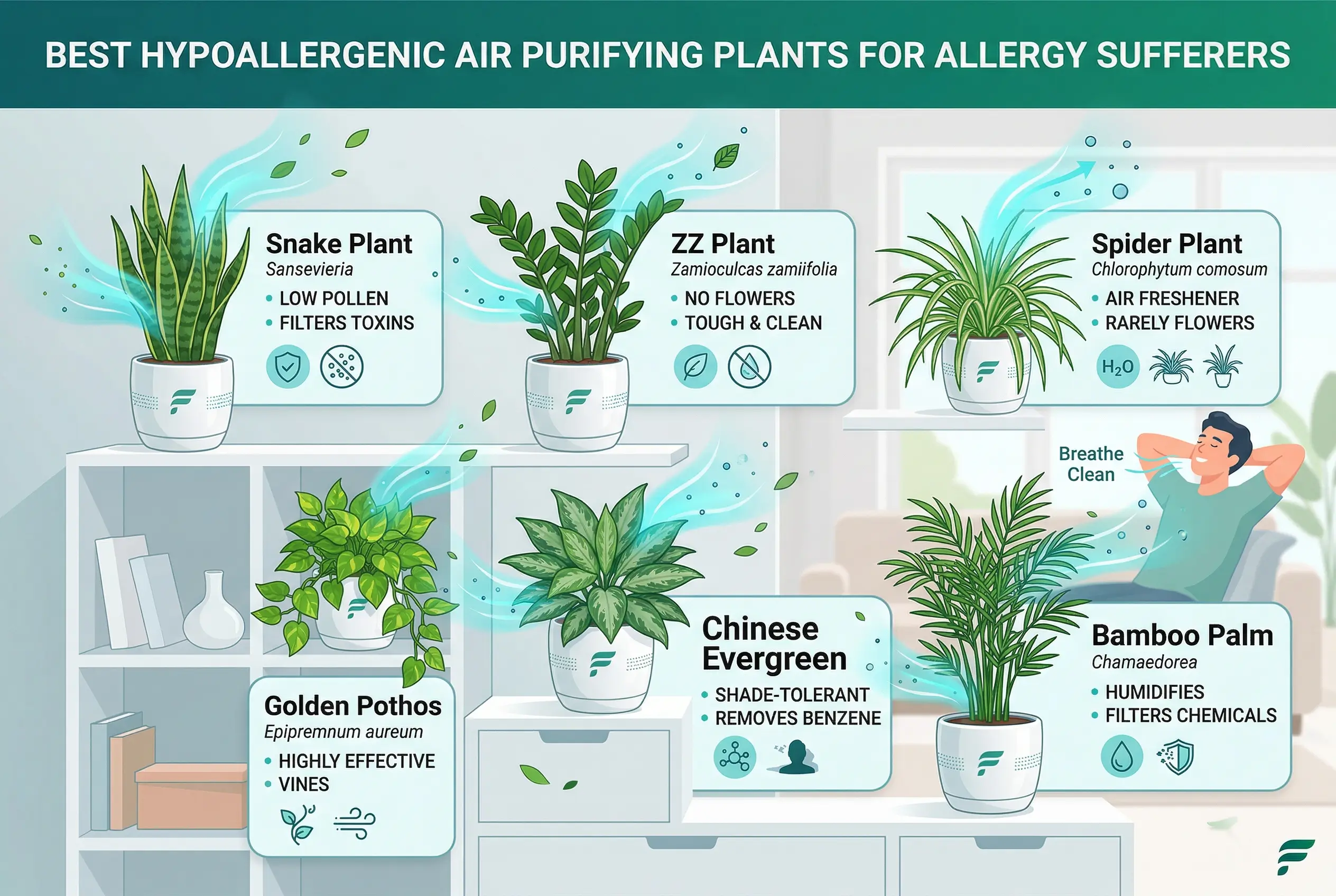
Peace Lily (Spathiphyllum)
The peace lily is one of the most widely recommended plants for allergy sufferers — and for good reason. It produces no airborne pollen, thrives in low light, and is recognized for its ability to absorb formaldehyde, benzene, and carbon monoxide from indoor air. It also acts as a natural humidifier, releasing moisture vapor that can ease dry, irritated airways. One important note: keep it away from pets and small children, as it is mildly toxic if ingested.
Snake Plant (Sansevieria trifasciata)
The snake plant is one of the few houseplants that converts carbon dioxide to oxygen at night, making it an excellent choice for bedrooms where allergy sufferers often struggle most. It requires minimal watering — which is key, because overwatered plants grow mold in their soil, a common trigger that undermines any air quality benefit. Low maintenance and near-impossible to overwater, it's a reliable first choice for anyone new to allergy-conscious plant care.
Areca Palm (Dypsis lutescens)
The areca palm functions as a natural air humidifier, particularly valuable during the heating season when indoor air becomes dry and more irritating to allergy-sensitive airways. It effectively filters xylene and toluene — VOCs commonly off-gassed by furniture finishes and household cleaners. It produces no airborne pollen and is non-toxic to pets, making it one of the most family-friendly options on this list.
Spider Plant (Chlorophytum comosum)
Spider plants are exceptional at removing formaldehyde and carbon monoxide — two pollutants that enter homes from gas appliances, cleaning products, and off-gassing materials. They are non-toxic, produce no airborne pollen, and are nearly indestructible, tolerating a wide range of light and watering conditions. Their rapid growth also means they absorb pollutants at a faster rate than slower-growing species.
Boston Fern (Nephrolepis exaltata)
The Boston fern is one of the most effective natural humidifiers available, restoring moisture to dry indoor air without introducing allergens. It filters formaldehyde and xylene efficiently and is non-toxic to both people and pets. The one caveat: it requires consistent moisture and humidity to thrive. Neglected, dry ferns can shed and create their own particulate mess — so only choose this plant if you're prepared to maintain it properly.
Dracaena (Dracaena spp.)
Dracaena species are among the broadest-spectrum air filters in the plant world, known to absorb benzene, formaldehyde, trichloroethylene, and xylene — a lineup of VOCs that shows up in homes with new furniture, flooring, or fresh paint. They grow slowly, require minimal watering, and produce no airborne pollen. Note that dracaena is toxic to cats and dogs, so placement matters in pet-owning households.
Bamboo Palm (Chamaedorea seifrizii)
Bamboo palms are one of the highest-rated natural air purifiers for formaldehyde removal and are particularly effective in rooms with new furnishings or recently installed flooring. They add humidity to dry environments, tolerate indoor light well, and are non-toxic to people and pets. Their size makes them well-suited to living rooms and bedrooms — rooms where families spend the most time breathing.
Plants Allergy Sufferers Should Avoid Indoors
Knowing what not to bring inside is just as important as knowing what to choose. Several popular houseplants are problematic for allergy sufferers despite their widespread appeal:
Ficus (Ficus benjamina): Sheds tiny latex particles and produces a sap that is a known allergen trigger for latex-sensitive individuals
Male palms: Some male palm varieties release airborne pollen indoors — always confirm the species before purchasing
Flowering plants with light pollen: Orchids, chrysanthemums, and certain flowering succulents release pollen that disperses freely in enclosed spaces
Heavily fragrant plants: Strong scents from plants like jasmine or gardenia can irritate chemical-sensitive airways even without producing true allergens
Any overwatered plant: Regardless of species, standing water in soil is a mold and mildew factory — one of the most overlooked indoor allergen sources we hear about from our customers
Why Plants Alone Aren't Enough
Here's the honest truth that most plant guides skip: houseplants improve indoor air quality at a passive, gradual rate. They are a valuable layer in your overall air quality strategy — but they don't trap the fine particulate matter, pet dander, dust mites, or mold spores already circulating through your home's air supply. That's the job of your HVAC air filter.
In our experience working with millions of households, the allergy sufferers who see the most improvement combine hypoallergenic plants with a high-performance air filter rated MERV 11 or higher. A MERV 11 filter captures particles as small as 1.0 micron — including the mold spores and fine dust that plants simply cannot absorb fast enough to make a meaningful real-time difference. Together, plants and proper filtration create a genuinely layered defense: one that addresses both gaseous pollutants and airborne particulates from every angle.
"After manufacturing air filters for over a decade and working with more than two million households, one pattern stands out clearly: allergy sufferers who rely on plants alone almost always plateau. Plants are genuinely valuable — they absorb VOCs that even the best air filter can't capture. But they work on a timescale of hours, not minutes, and they do nothing for the fine particulate matter and biological allergens that your HVAC system is actively circulating through every room. The homes where we see the biggest improvement in air quality are the ones where the right plants and the right filter are working together. Neither replaces the other — they cover different threats. That layered approach is what actually moves the needle for allergy sufferers."
Essential Resources
Protecting your family's air starts with the right information. After over a decade of manufacturing air filters and helping more than two million households breathe cleaner air, we know that confident decisions come from credible sources. Here are the resources we trust — and recommend — when it comes to hypoallergenic plants, indoor pollutants, and air filtration:
NASA Clean Air Study — The foundational research behind everything you've read on this page. NASA scientists documented which common houseplants absorb specific indoor pollutants like formaldehyde, benzene, and VOCs in controlled environments. If you want to understand the science behind plant-based air purification at the source, this is where to start. https://ntrs.nasa.gov/api/citations/19930073077/downloads/19930073077.pdf
ASPCA Toxic and Non-Toxic Plant Database — Before any plant enters your home, this is the resource to check. The ASPCA maintains a comprehensive, searchable database of plants that are safe — and unsafe — for cats, dogs, and horses. For allergy-sensitive households with pets, confirming a plant's safety profile here is a non-negotiable first step. https://www.aspca.org/pet-care/aspca-poison-control/toxic-and-non-toxic-plants
U.S. Environmental Protection Agency: Guide to Air Cleaners in the Home — The EPA's guide explains how different air cleaning strategies — mechanical filters, electronic purifiers, and natural methods — address different types of indoor pollutants. It's the clearest government-sourced explanation of why plants and HVAC filtration serve complementary, not competing, roles in your home. https://www.epa.gov/indoor-air-quality-iaq/guide-air-cleaners-home
Filterbuy: All About MERV Ratings — Understanding your air filter's MERV rating is the other half of the equation. This guide explains what MERV ratings mean, which rating is right for allergy sufferers, and how filter performance directly affects the particulate matter that plants cannot capture. https://filterbuy.com/resources/air-filter-basics/all-about-merv-ratings/
Filterbuy: How to Remove VOCs from Indoor Air — VOCs are the invisible gaseous pollutants that plants help absorb — but the full picture includes where they come from and how to reduce them at the source. This guide covers practical, homeowner-focused strategies for identifying and eliminating VOC sources in your home before they reach the air you breathe. https://filterbuy.com/resources/health-and-wellness/best-practices-for-homeowners-on-how-to-remove-vocs-from-air/
Supporting Statistics
After manufacturing air filters for over a decade and serving more than two million households, we've learned that most allergy sufferers are fighting a battle they can't see — inside the very space they believe is safest. Here is what the research confirms.
82 million Americans are now diagnosed with seasonal allergic rhinitis.
More than 67 million adults and 14 million children carried a seasonal allergy diagnosis in 2024
In our experience, this is the reality behind why so many households contact us about indoor air quality
Allergies have become a whole-home issue — not a seasonal inconvenience
The families who take indoor air quality seriously aren't outliers. They're the majority
Source: Asthma and Allergy Foundation of America — Allergy Facts and Figures (2026) https://aafa.org/wp-content/uploads/2025/04/aafa-allergy-facts-and-figures.pdf
Americans spend roughly 90% of their time indoors — where pollutant concentrations run 2 to 5 times higher than outdoors.
The EPA ranks indoor air pollution among the top five environmental health risks facing the public
What surprises most customers: the pollution driving those numbers isn't coming from outside — it's generated inside
Building materials, cleaning products, furnishings, and combustion appliances off-gas silently, day and night
The people most at risk — the very young, older adults, and those with respiratory conditions — also spend the most time indoors
Source: U.S. Environmental Protection Agency — Indoor Air Quality https://www.epa.gov/report-environment/indoor-air-quality
VOC concentrations indoors can reach up to 10 times higher than outdoor levels.
The EPA's TEAM Study documented this across homes in both rural and highly industrial areas — geography offers no protection
VOCs pass right through mechanical filtration. That's where gas-absorbing plants carry their real weight
A high-MERV filter captures fine particulate matter and biological allergens
The right plants address the gaseous pollutants filters can't catch
Neither solution replaces the other — together, they cover the full spectrum
Source: U.S. Environmental Protection Agency — Volatile Organic Compounds' Impact on Indoor Air Quality https://www.epa.gov/indoor-air-quality-iaq/volatile-organic-compounds-impact-indoor-air-quality
Nearly 1 in 3 American adults — 31.8% — had a diagnosed seasonal allergy, eczema, or food allergy in 2021.
Women showed a higher rate of seasonal allergy diagnosis (29.9%) compared to men (21.1%)
Prevalence was significant across every adult age group surveyed
Allergic conditions are not a niche health concern — they cut across age, demographics, and geography
For households where multiple family members manage sensitivities, a whole-home air quality strategy isn't optional. It's essential.
Source: CDC National Center for Health Statistics — NCHS Data Brief No. 460 (January 2023) https://www.cdc.gov/nchs/products/databriefs/db460.htm
Final Thoughts
After more than a decade of manufacturing air filters and working with millions of households, our perspective is clear: the allergy conversation in this country focuses too much on symptoms and not nearly enough on sources.
Most allergy sufferers have tried:
Medications and antihistamines
Seasonal avoidance strategies
Far fewer have examined what is already living inside their home's air — the VOCs off-gassing from flooring and furniture, mold spores breeding in an overwatered plant, fine particulate matter cycling through an unchanged filter. The symptoms are visible. The causes almost never are.
That is the insight that shapes everything we recommend.
Hypoallergenic plants work — but only when you choose and maintain them correctly.
The wrong plant species can introduce pollen and mold spores that worsen symptoms
An overwatered plant, regardless of species, becomes a mold source
Plant guides that skip this nuance aren't doing allergy sufferers any favors
Our opinion, formed from years of real-world experience: no single solution wins.
Not plants alone. Not filtration alone. The households that see the most meaningful improvement treat indoor air quality as a system:
Gas-absorbing plants handle the invisible chemical burden — VOCs that mechanical filters cannot capture
A high-performance MERV-rated filter captures the fine particulate matter and biological allergens that plants cannot touch
Consistent maintenance keeps both working at full effectiveness
That layered approach isn't complicated. It doesn't require a major investment or a complete home overhaul. It requires understanding what each tool actually does — and what it doesn't.
You now have that understanding. The right plants and the right filter are the two most practical steps you can take today to protect the people breathing the air inside your home. Little effort. Meaningful impact.
FAQ on Air Purifying Plants
Q: Do air purifying plants actually work, or is it just a marketing claim?
A: They work — but not the way most people expect. Here is what the evidence and our experience show:
NASA's Clean Air Study confirmed plants absorb formaldehyde, benzene, and VOCs through their leaves and root systems
Plants work on a timescale of hours — not minutes
They do nothing for airborne particulates already cycling through your HVAC system
Their real value is filling the gap mechanical filtration leaves open: gaseous pollutants
Paired with a quality air filter, plants contribute meaningfully. Used alone, they plateau
Q: Which air purifying plants are safest for allergy sufferers?
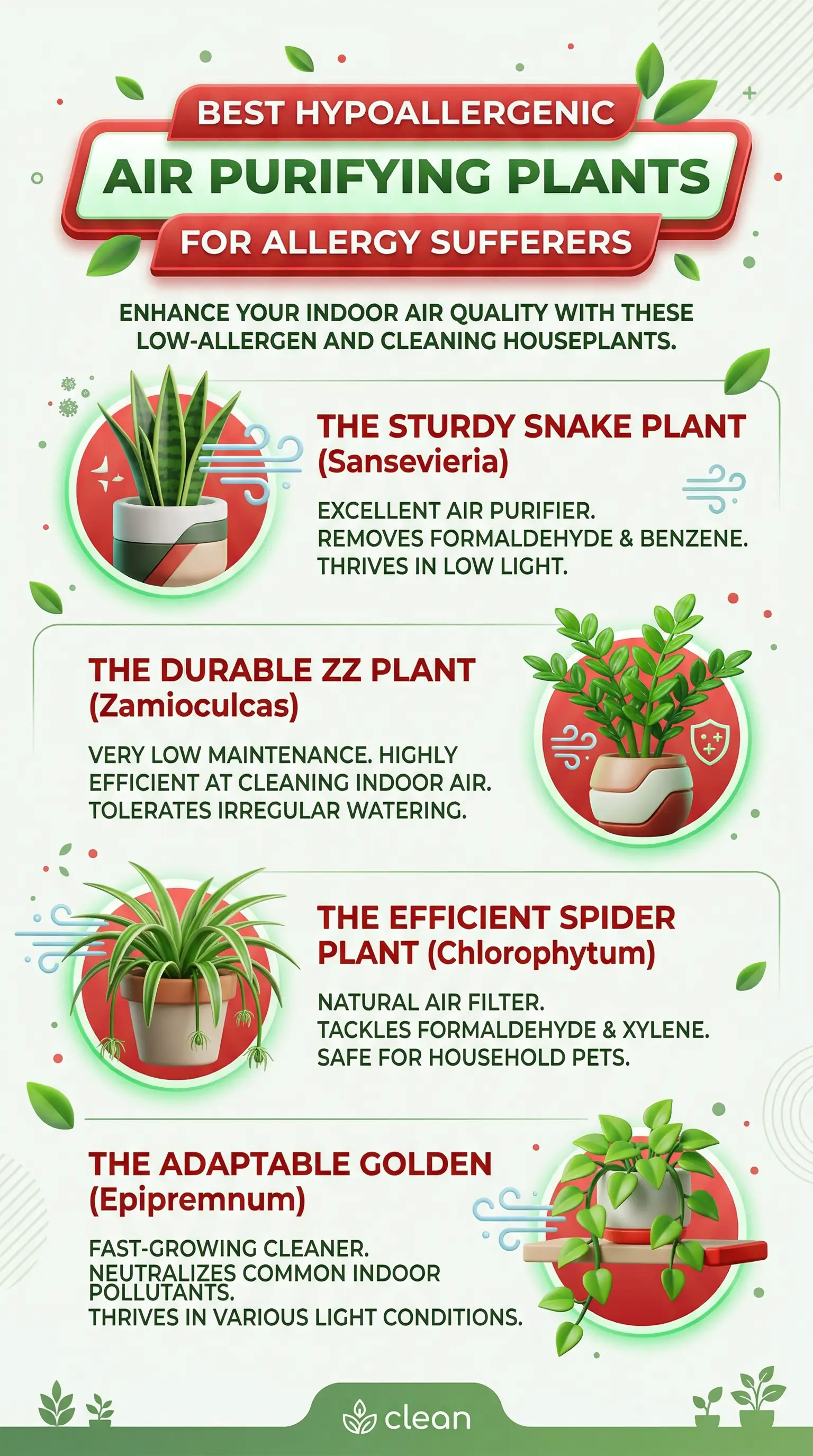
A: The safest options share three traits: no airborne pollen, no mold risk under normal care, and documented VOC absorption. Our most consistent recommendations for allergy-sensitive households:
Peace lily — absorbs formaldehyde, benzene, and carbon monoxide
Snake plant — converts CO2 to oxygen overnight; nearly impossible to overwater
Spider plant — non-toxic, fast-growing, exceptional formaldehyde absorber
Areca palm — pet-safe natural humidifier; filters xylene and toluene
Dracaena — broadest-spectrum VOC absorber on this list; toxic to pets, so placement matters
Boston fern — powerful humidifier; requires consistent moisture to stay effective
Bamboo palm — best-in-class for formaldehyde removal; non-toxic to people and pets
Q: How many plants do I need to make a noticeable difference?
A: NASA recommends one to two medium plants per 100 square feet for meaningful VOC reduction. In practice:
Placement matters more than quantity
Prioritize rooms where your family spends the most time breathing
Two well-maintained bedroom plants outperform six neglected plants scattered throughout the home
Start with bedrooms, living rooms, and nurseries first
Get those right before scaling up
Q: Can houseplants actually make allergy symptoms worse?
A: Yes — and this is the warning most plant guides skip. Specific risks to know:
Ficus sheds latex particles that trigger reactions in latex-sensitive individuals
Flowering plants like orchids and chrysanthemums disperse light pollen freely indoors
Heavily fragrant plants like jasmine irritate chemical-sensitive airways
Any overwatered plant — regardless of species — breeds mold and mildew in its soil
Choosing the right species is only half the equation. Maintaining them correctly is the other half.
Q: Should I choose an air purifying plant or an air purifier — or do I need both?
A: Both — because they solve different problems entirely. After manufacturing air filters for over a decade and working with more than two million households, the pattern is clear:
Plants absorb gaseous pollutants and VOCs that filters cannot capture
MERV-rated air filters capture fine particulate matter, mold spores, and biological allergens that plants cannot address fast enough to matter
These are two distinct categories of indoor air threat
No single tool addresses both effectively
The households that breathe easiest aren't choosing between plants and filtration. They're running both.
Breathe Easier With the Right Plants and the Right Filter
You now know which hypoallergenic plants protect your home's air — pair them with a Filterbuy MERV-rated air filter to capture the allergens and fine particulate matter that plants alone can't address. Shop Filterbuy air filters today and build the layered defense your family's air quality deserves.