TL;DR Quick Answers
chicago air quality
Chicago's air quality shifts hour by hour, driven mainly by ground-level ozone, traffic and industrial PM2.5, and wildfire smoke drifting in from Canada. I check the current AQI before making outdoor plans rather than judging by the sky. Under 100 is fine for most people. Above 100, sensitive groups like kids, older adults, and anyone with asthma or heart disease should limit outdoor time.
Main drivers: ground-level ozone, traffic and industrial PM2.5, and Canadian wildfire smoke
Safe threshold: under 100 AQI for most people, with caution above that for sensitive groups
Check it live: ZIP-code lookups on AirNow.gov update throughout the day
Top Takeaways
A Chicago air quality alert means the Illinois EPA expects the AQI to reach Orange (Unhealthy for Sensitive Groups) or worse.
An Areawide Action Day covers most of the state at once. A Red Action Day is narrower and more serious.
Ground-level ozone, PM2.5 from traffic and industry, and Canadian wildfire smoke are the three main triggers behind Chicago's alerts.
Canada is having one of its most severe wildfire seasons on record this year, which explains why smoke-driven alerts have kept returning.
Once an alert clears, air quality on the ground often lags behind the official all-clear by an hour or more.
Checking current conditions before heading outside beats guessing based on how the sky looks.
How an Illinois Air Pollution Action Day Works
The Illinois EPA calls a Chicago Air Pollution Action Day when forecasters expect the AQI to reach the Orange, or Unhealthy for Sensitive Groups, category or worse. An Areawide Action Day covers nearly every forecast sector in the state at once, which usually happens during a widespread ozone spike or a large wildfire smoke event. A Red Air Pollution Action Day is more serious and narrower. Forecasters call it when the Red or Unhealthy category is expected across a specific stretch of the state, Chicago included. I check which type of alert is in effect before I decide how much it should change my plans, and make sure a high quality filter is helping maintain cleaner indoor air whenever outdoor pollution is expected to remain elevated. A statewide Orange day calls for caution. A Red day calls for real restraint.
Reading the AQI Color Scale Without the Jargon
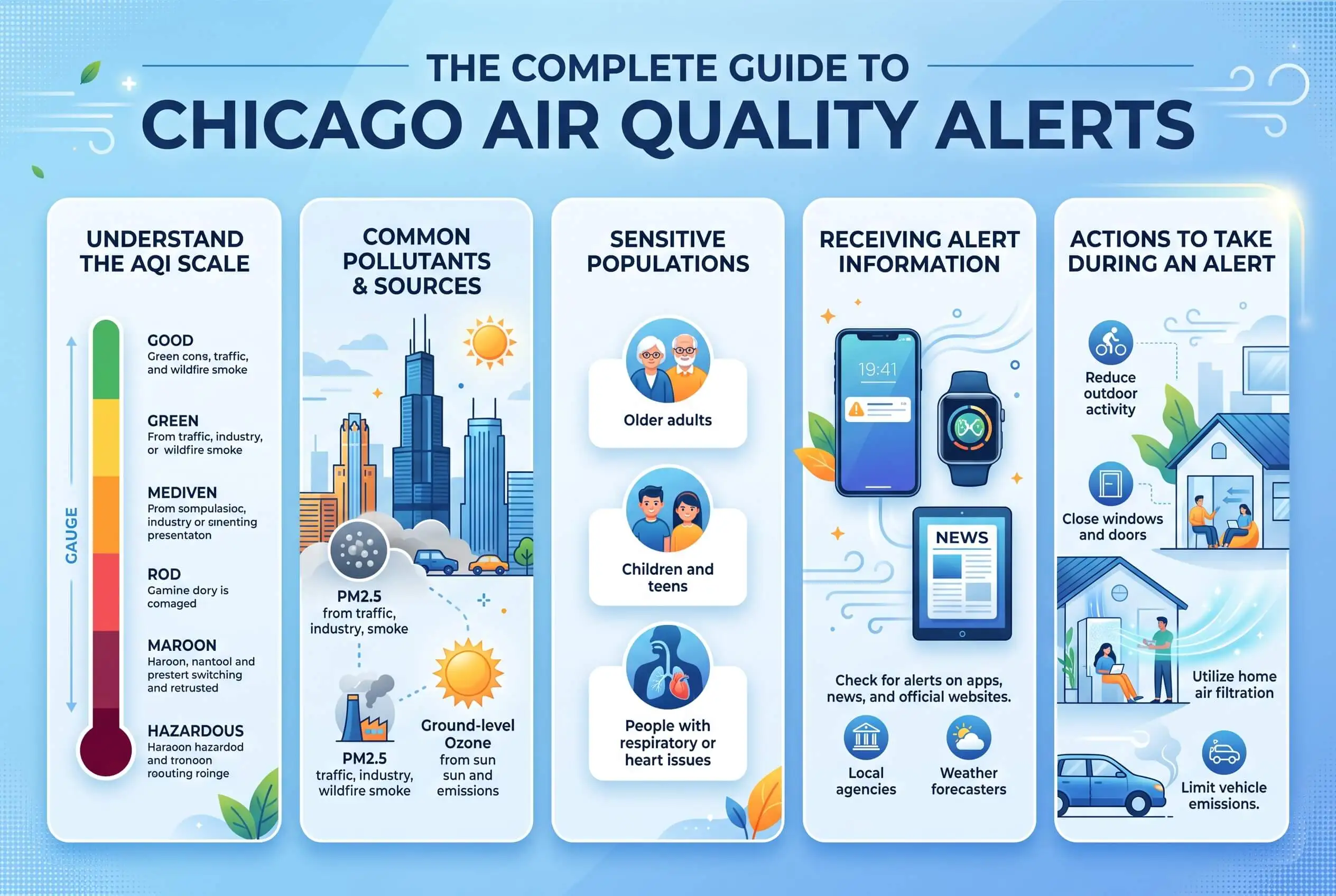
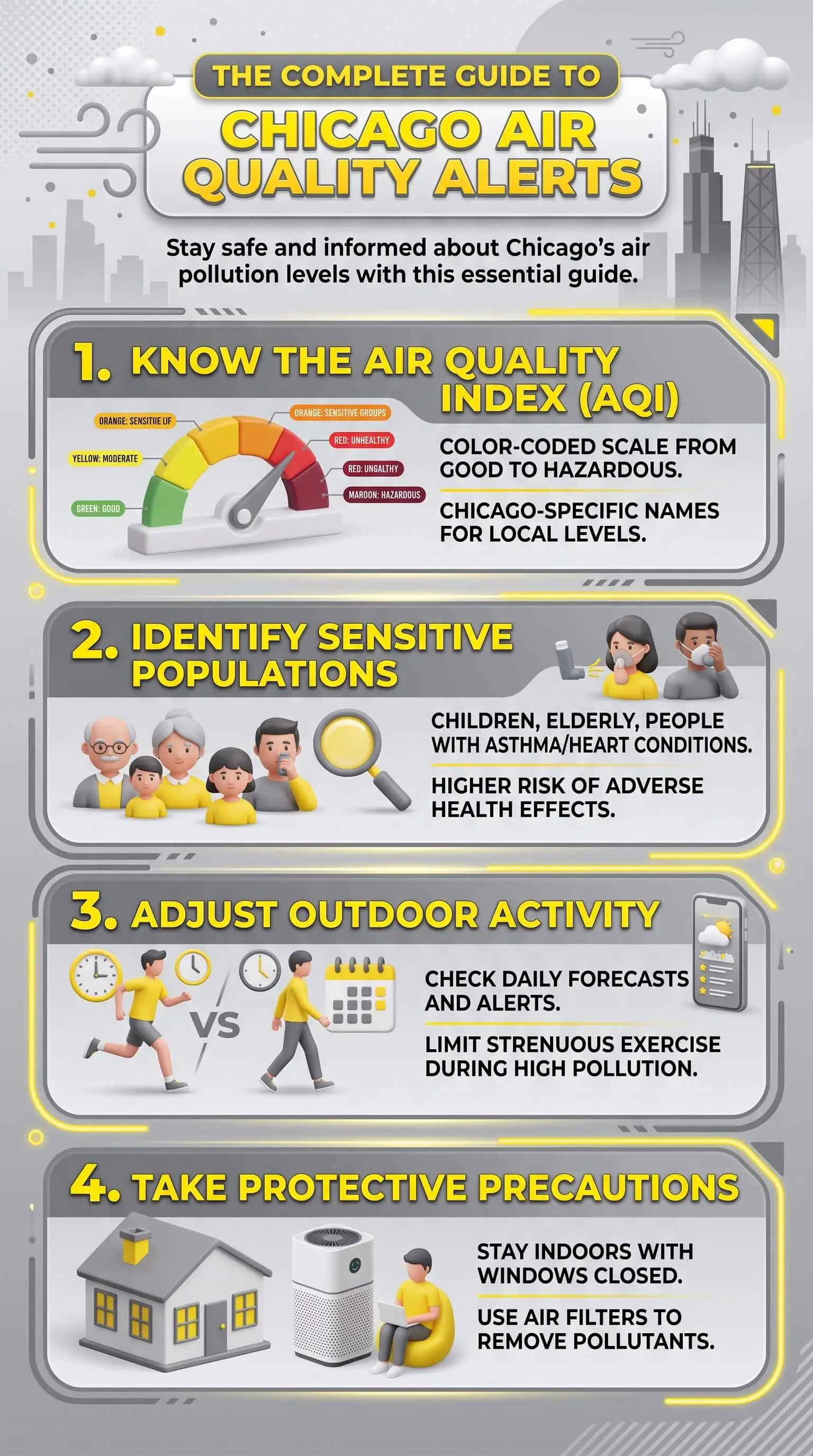
The AQI runs from 0 to 500. Green (0-50) means the air is fine for everyone. Yellow (51-100) is acceptable for most people but worth watching if you have asthma or another respiratory condition. Orange (101-150) is where the alerts start, and it means kids, older adults, and anyone with heart or lung disease should cut back on prolonged outdoor activity. Red (151-200) means everyone should start limiting time outside. Purple or Maroon above that means I keep outdoor plans to the bare minimum, regardless of how I personally feel that day.
What Actually Puts Chicago on Alert
Ground-level ozone builds on hot, sunny days, when vehicle and industrial emissions react with sunlight and peak by summer afternoon. Fine particulate matter, PM2.5, comes from traffic, industry, and combustion, and it spikes in winter inversions just as easily as summer heat waves. Then there's the wildcard: wildfire smoke drifting down from Canada. Canada logged one of its most severe wildfire seasons on record this year, and smoke from those fires has pushed south into the Great Lakes region again and again, triggering Chicago Action Days that have nothing to do with anything happening in Illinois.
What I Actually Do When the Alert Hits My Phone
I start by checking the current reading rather than trusting my nose, since smoke can thin out visually before the particle count actually drops. If the AQI is Orange or worse, I move exercise indoors and keep windows closed. If smoke is the cause, I set up a portable air cleaner in the room where I spend the most time and skip anything that adds its own particles indoors, like frying food or lighting candles. I also use indoor air quality testing to confirm when conditions inside my home have improved. Once the alert clears, I give it another hour or two before I fully trust that the air outside has caught up with the official all-clear.
“After tracking enough of these Action Days now, I've noticed the alert almost always outlasts the smell of smoke in the air by a full day or more, so I've stopped trusting my nose to tell me when it's over and started waiting for the official all-clear instead.”
7 Essential Resources
AQI Basics - The EPA's plain-language breakdown of how the Air Quality Index works and what each color category means for your health. airnow.gov/aqi/aqi-basics
Illinois EPA Outdoor Air - The state's own explanation of how Air Pollution Action Days get called, including the difference between Areawide and Red alerts. epa.illinois.gov/topics/air-quality/outdoor-air
CDC Wildfire Smoke Safety Guidelines - Federal guidance on protecting yourself and your family during a smoke event, including who faces the highest risk. cdc.gov/wildfires/safety
City of Chicago Air Pollution Action Day Notices - The city's own emergency management updates on active Action Days, including which counties and time windows are covered. chicago.gov Air Pollution Action Day notice
NWS Chicago Forecast Office - The National Weather Service office that issues and updates air quality alerts for the Chicago metro area. weather.gov/lot
EPA Indoor Air Quality: The Inside Story - A federal guide to what actually happens to pollution levels once outdoor air makes its way inside your home. epa.gov/indoor-air-quality-iaq
National Interagency Fire Center Statistics - Live, federally maintained tracking of wildfire activity across North America, useful for understanding why smoke keeps arriving from Canada. nifc.gov/fire-information/statistics
These trusted resources help you monitor Chicago air quality alerts, understand changing pollution conditions, and know when air purifiers can help maintain cleaner indoor air during ozone events, wildfire smoke, and other periods of poor outdoor air quality.
3 Statistics
Canada logged more than 11 million hectares, or roughly 27 million acres, of wildfire burn this year as of its update on the ongoing fire season, one of its most severe on record and a direct driver of the smoke that has repeatedly reached Chicago. Source: nifc.gov.
The Chicago-Naperville metro area ranked 15th worst in the nation for ozone pollution in the American Lung Association's 2026 State of the Air report, with Cook County receiving an F grade and averaging 18 unhealthy ozone days per year. Source: lung.org.
In 2024, the EPA tightened the primary annual PM2.5 air quality standard from 12.0 to 9.0 micrograms per cubic meter, a 25 percent reduction meant to reflect updated health science on fine particle pollution. Source: federalregister.gov.
These statistics show why staying prepared for changing outdoor air conditions matters, and why using a quality air filter can help maintain cleaner indoor air when wildfire smoke or elevated pollution affects the Chicago area.
Final Thoughts and Opinion
I used to treat a Chicago air quality alert as background noise, one more line on a weather app to scroll past. That stopped after I noticed how often the bad days were stacking up: summer ozone, winter inversions, and now wildfire smoke that starts hundreds of miles away in a Canadian forest and still manages to make my eyes water on a walk to the store. I can't do anything about any of that. What I can do is check the alert before I plan my afternoon, make sure my indoor air holds up on the days the outdoor air doesn't, and take simple steps to improve indoor air quality at home. That part is actually mine to control, and it's worth taking seriously before the next alert lands.
 Frequently Asked Questions
What does a Chicago air quality alert mean?
It means the Illinois EPA or the National Weather Service expects pollution to reach the Orange (Unhealthy for Sensitive Groups) category or worse. It's a signal to limit outdoor time, especially for children, older adults, and anyone with asthma, COPD, or heart disease, while ensuring your home has the best HVAC replacement and filtration system to help maintain cleaner indoor air during poor air quality events.
What's the difference between an Areawide and a Red Air Pollution Action Day?
An Areawide (or Statewide) Action Day covers nearly all of Illinois's air quality forecast sectors at the Orange level or worse. A Red Air Pollution Action Day is narrower and more serious, called when a specific region, often including Chicago, is forecast to reach the Red or Unhealthy category.
Is it safe to exercise outside in Chicago today?
Check the current AQI first. Below 100, most people are fine for normal outdoor activity. Above 100, sensitive groups should move exercise indoors, and above 150, that guidance extends to almost everyone.
Why does Chicago keep getting wildfire smoke from Canada?
Canada has experienced back-to-back severe wildfire seasons, and prevailing winds carry that smoke south and east into the Great Lakes region. Chicago sits directly in a common path for that smoke, which is why alerts driven by fires hundreds of miles away have become a recurring summer pattern rather than a rare event.
Do air quality alerts affect people without asthma or existing health conditions?
Yes, at higher AQI levels. Orange-level air mainly affects sensitive groups, but Red, Purple, and Maroon levels can cause eye irritation, coughing, and reduced lung function in otherwise healthy people, especially with prolonged outdoor exposure. Using MERV 8 filters indoors can help reduce airborne particles and support cleaner indoor air when outdoor pollution reaches these higher AQI levels.
How do I check Chicago's air quality by ZIP code?
AirNow.gov accepts ZIP code searches and pulls readings from the nearest monitoring station, updated throughout the day as conditions change.
Does closing my windows actually help during an alert?
Yes. Closing windows and doors keeps outdoor particles from building up indoors, and it matters most during wildfire smoke events, when outdoor PM2.5 levels can be many times higher than what you'd see on an ordinary bad-ozone day.
CTA
Knowing what triggers a Chicago air quality alert only gets you so far if you don't know where things stand right now. This live Chicago AQI map tracks today's readings by neighborhood, so you can catch the next spike before it catches you and decide when pleated furnace filters can help maintain cleaner indoor air while outdoor pollution levels remain elevated.